.svg)
.svg)

This guide was developed for CFOs and finance leaders evaluating Anaplan and Oracle EPM for their FP&A needs. It provides a straightforward comparison based on user feedback and product research about their usability, implementation, integrations, performance, and AI features.
We dive into the strengths, weaknesses, and ideal buyers for each platform and introduce Drivetrain as a strong alternative—one that doesn’t impose the complexity and lengthy implementation times that come with Anaplan and Oracle EPM. This guide will leave you with a much better sense of what all three platforms have to offer and provide a decision framework to help you select the right FP&A solution for your organization.
.svg)
.svg)

.svg)

If you're a CFO or finance leader considering transitioning to your first FP&A platform or migrating from your current system, you already understand the stakes involved. You know this decision will impact your company for years and can have a very real impact on our business success.
The right choice can streamline your team's operations, making the finance function and your business more agile and strategic. Get it wrong, and you're stuck explaining to the CEO why forecasts still take three weeks and why that expensive new system is underused.
This guide simplifies FP&A tool selection for CFOs and finance leaders by combining verified user reviews, cross-referenced vendor positioning information, and synthesized insights from finance-focused content across the industry.
Our Anaplan vs. Oracle EPM analysis focuses on key factors like implementation, integration, flexibility, governance, AI features, and the real-world trade-offs you’ll face depending on the platform you choose. We’ll also introduce you to Drivetrain, a modern alternative built for dynamic finance teams.
Let’s start with a review of Anaplan.
Evaluating Anaplan: strengths, weaknesses, best fit
Anaplan is known for its cloud-native planning platform with strong modeling capabilities across budgeting, forecasting, workforce planning, and scenario analysis.
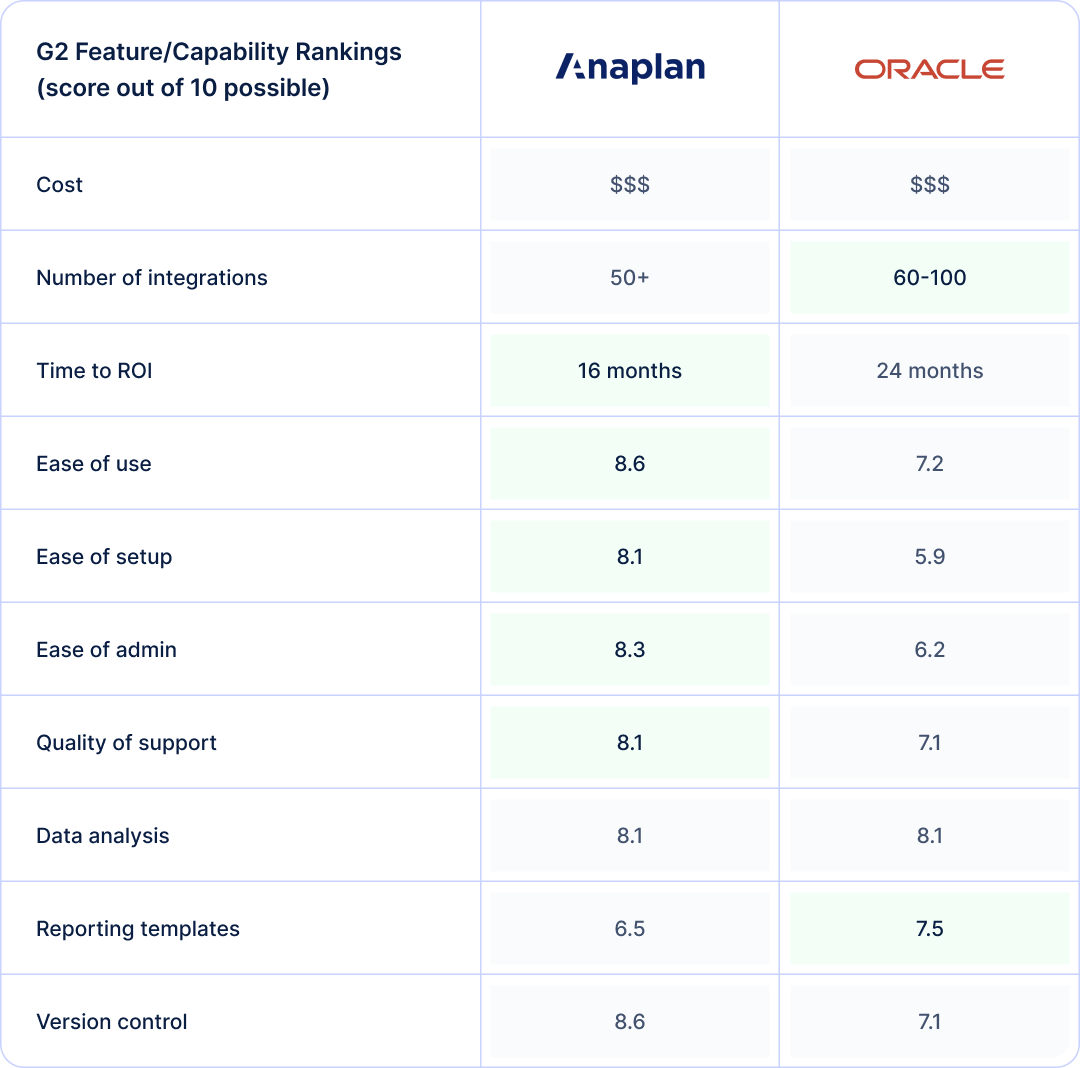
However, Anaplan is also known for lengthy implementations that rely heavily on third-party consultants. Integrations beyond the native 50+ connectors it offers will require either middleware or a custom build, both of which require deep technical expertise. And while the interface is user-friendly, fully unlocking Anaplan’s potential still demands skilled model builders.
What are Anaplan’s core strengths?
- Flexible modeling engine: The versatile modeling engine allows users with advanced modeling skills and technical expertise to create elaborate models with numerous dimensions to plan in all areas of finance, supply chain, HR, and sales.
- Connected planning capabilities: Real-time connectivity provides finance teams with the ability to update information and connect with all users instantaneously.
- Scalable: The platform can be configured for enterprise-grade complexity, including multi-entity, multi-currency, and organizational structures where mergers and acquisitions are common.
- Customization capabilities: While it requires significant technical expertise to customize, the platform has extensive capabilities for tailoring business logic, building driver-based models, and what-if scenarios.
What are Anaplan’s weaknesses?
- Long implementation timelines: Implementation typically requires six months or more with a consultant-heavy setup. That dependency doesn't end after launch, and reviews suggest that many teams don't see meaningful ROI until 16 months in.
- Steep learning curve: Anaplan's modeling environment isn't intuitive for non-technical users. Building and maintaining models requires significant expertise, so you'll either need a dedicated group of superusers, professional services, or the assistance of external consultants.
- Performance degradation under load: Users report slowdowns when running complex calculations across large datasets, especially during peak planning periods. Refreshing reports or processing scenario changes can test your patience and timelines.
- Limited agility for fast-moving teams: Making structural changes, such as adding new dimensions and reorganizing hierarchies, requires technical skill beyond that of most finance teams. Having to rely on IT and/or external consultants to make such changes takes time. As a result, fast-growing companies or those that frequently pivot find Anaplan cumbersome.
- Feature gaps and integration friction: Reviewers note shortcomings in terms of functionality, such as robust version control, multi-filter capabilities, and integrations, which often require the additional expense of third-party middleware.
When does Anaplan make sense?
Anaplan is purpose-built for large enterprises or structurally complex organizations where planning sophistication might justify the investment.
Anaplan might be a good fit if you:
- Operate across multiple business units, geographies, or currencies, and need a single source of truth for connected planning.
- Are willing to invest 12–18 months to fully achieve the flexibility you need.
- Have a dedicated in-house team of advanced model builders and IT experts (often referred to as a Center of Excellence or CoE) with the skills needed to maintain the platform in the long term.
- Have the budget to hire external consultants to assist with your implementation and ongoing maintenance needs (a possible alternative to hiring the expertise you would need for a CoE).
You may struggle with Anaplan if you:
- Need an end-to-end EPM software with robust financial close, deep consolidation, and statutory reporting as much as planning.
- Don’t have a dedicated FP&A infrastructure or the technical resources to manage ongoing maintenance of your models and integrations.
- Don't want to become dependent on external consultants, either because you don’t have the budget for that and/or the patience to wait for changes and updates to the system integrations and models you’ll invariably need over time.
- Need to go live in less than six months (Anaplan’s typical implementation timeframe).
Evaluating Oracle EPM: strengths, weaknesses, best fit
Oracle EPM Cloud is a comprehensive, end-to-end financial management suite. It offers budgeting and forecasting, multi-entity consolidations, close processes, account reconciliations, narrative reporting, and the ability to manage profitability, costs, and taxes in a single platform.
Oracle EPM gives finance teams a unified platform to manage complex regulatory requirements, multi-GAAP reporting, and intricate consolidation hierarchies. However, its complexity makes things challenging if you value speed, simplicity, or lightweight deployment.
For example, implementation timelines typically stretch to seven months or more, and reviewers consistently point out the steep learning curve, which can be especially challenging for those new to the Oracle ecosystem.
You'll also need experienced administrators and/or external consultants to help you manage changes to your models and to build and maintain integrations to ensure smooth data flows. In addition, large data volumes can strain the system, resulting in performance issues.
What are Oracle EPM’s biggest strengths
- Deep governance and audit controls: Oracle EPM provides the necessary features and capabilities to stand up to the reporting requirements of public companies and/or organizations operating in heavily regulated industries.
- Native integration with Oracle ERP and Analytics: Integration with Oracle products is easier than with other systems for organizations with existing investments in the Oracle ecosystem.
- High scalability: The platform is highly scalable in terms of its ability to support large enterprises with complex hierarchies, multi-entity operations, and global reporting needs.
What are Oracle EPM’s most significant weaknesses?
- Technical barriers: Users often complain that Oracle EPM is difficult to learn and operate. Non-technical finance users struggle with the interface, and even routine tasks like building reports or adjusting dimensions often require IT or admin intervention.
- Resource-intensive implementations: Implementation typically requires a minimum of seven months with a heavy reliance on Oracle-certified consultants. This is due to the inherent complexity of the platform, whose modular architecture requires you to configure multiple interconnected applications, each with its own learning curve and integration points.
- Performance issues at scale: Users note slow report refreshes, lags during peak planning cycles, and system instability when processing large data volumes or complex hierarchies.
- Integration friction outside Oracle: While Oracle-to-Oracle connections work well, linking EPM to non-Oracle ERPs, external CRMs, and data lakes often requires expensive middleware, custom-built connectors, and ongoing maintenance, all of which require IT expertise that few finance professionals possess. As a result, the promised ability to seamlessly integrate planning with external systems often doesn't align with what finance teams actually experience.
When does Oracle EPM make sense?
Oracle EPM targets large companies with complex financial needs, especially those that already use other Oracle software.
Oracle EPM might be a good fit if you:
- Are already heavily invested in the Oracle ecosystem with applications such as Oracle ERP Cloud, Fusion, or NetSuite, and don’t need to integrate with many (or any) external data systems.
- Your organization has time for an implementation that will take 7+ months, and the budget for the external Oracle-certified consultants that are typically required to get your system and integrations installed and configured.
- You have a dedicated IT team with skilled Oracle administrators or the budget for external consultants to manage the technical complexity and ongoing system maintenance.
You may struggle with Oracle EPM if you:
- Are a smaller enterprise or mid-sized company without Oracle infrastructure or dedicated technical support.
- Are looking for speed and agility in your day-to-day FP&A.
- Have a diverse tech stack that will require technical expertise, plus or minus third-party middleware to set up, configure, and maintain the integrations you need.
- Are working with a finance team that prefers user-friendly tools over a steep learning curve and IT involvement.
Anaplan vs. Oracle EPM: direct feature and experience comparison
Anaplan and Oracle EPM tackle the same FP&A problem from two different angles. Anaplan is built around multi-dimensional modeling and cross-functional collaboration. Oracle EPM is a complete financial management suite focused on consolidation, close, and compliance.
Both Anaplan and Oracle EPM take roughly the same amount of time to go live (6–7 months appears to be the typical implementation timeline). However, achieving an ROI on the investment is a different story. While organizations adopting Anaplan can usually achieve ROI in around 16 months, it can take two years with Oracle EPM.
This is due largely to the fact that both platforms require heavy consultant involvement both for implementation and ongoing maintenance. They also commonly require investments in training for users to be able to use even their more basic features.
In terms of AI capabilities, Oracle highlights features like predictive forecasting, anomaly detection during close, intelligent reconciliation, and automated narrative reporting. However, these tools often require significant data preparation, model training, and fine-tuning to deliver real value.
Users find Oracle's AI performs well in high-volume tasks like transaction matching but falls short on more complex tasks, such as autonomous insights or proactive recommendations. Additionally, the algorithms often lack transparency, making it hard for finance teams to trust or explain AI-generated outputs.
Anaplan's PlanIQ uses machine learning (ML) and statistical models to improve forecasting and scenario planning. It can predict outcomes and identify unusual data points in your planning process. While an improvement over its previous version, users report that Anaplan's AI still requires significant manual effort, including data cleaning and model validation to achieve accurate predictions.
Where both Anaplan and Oracle EPM fall short for dynamic finance teams
Both Anaplan and Oracle EPM are robust in terms of their features and capabilities. However, the power they offer comes at the expense of the user—literally, in terms of TCO, and figuratively, through the user experience. In this section, we’ll highlight how these issues play out in three areas where both platforms consistently fall short for dynamic finance teams.
Complexity that slows finance teams down
Anaplan and Oracle EPM are powerful enterprise platforms, but they were built for an era of FP&A when planning happened quarterly, with simpler tech stacks that required fewer integrations, and real-time data wasn’t yet real.
Anaplan and Oracle EPM are both legacy platforms that reflect the architectural assumptions of their time. For example, Anaplan's proprietary modeling syntax, which requires extensive training, and Oracle EPM's heavy complex calculation scripting languages were design choices that made sense when finance teams had months to implement systems, and IT departments managed all technical configurations.
However, enterprises today need to plan continuously and stay agile to remain competitive in today's market—and that requires technologies that can keep up.
Lengthy implementation cycles and the heavy reliance on external consultants undermine the agility that finance leaders expect from their FP&A tools.
Both platforms suffer from legacy design choices that prioritize power over usability. User reviews indicate that both Anaplan and Oracle EPM struggle to meet the demands of modern finance teams for speed, automation, adaptability, and self-sufficiency. And these limitations become more apparent as companies grow, reorganize, or adopt a more agile operating model.
Gaps in integration that add to TCO and undermine agility
Integration is a persistent pain point for users of both platforms. Oracle EPM offers more native integrations than Anaplan; however, both platforms still require significant technical expertise to configure them.
Similarly, regardless of which platform you might choose, if you need to connect to a system that it doesn’t integrate with natively, you can expect to incur the additional costs associated with having a developer build the integration from scratch using an API. You may incur additional costs for middleware to facilitate the connection, the initial setup, configuration, and testing of the integration, as well as ongoing maintenance to ensure a reliable data flow.
These costs won’t show up in your contract with Anaplan or Oracle EPM, but they are real, significant, and baked into both platforms by virtue of their complexity. Predicting them is difficult, too, especially the ongoing maintenance. This is because complex integrations, whether custom-built or connected via middleware, are highly fragile.
Any changes in your financial models, such as changes in your hierarchies or new cost drivers, can “break” your integration. The data may still flow into the platform, but it won’t be reliable until your IT team or the external consultants you’ve hired to reconfigure the integration accordingly.
There’s also the opportunity costs associated with lost agility to consider. When every change requires intervention from a technical expert, whether internal or external, agility simply doesn’t exist.
To achieve true agility, finance must “own” the model and the FP&A platform it’s running on—the finance team should be able to create and configure integrations to the systems they need and make changes to their models, without having to wait for IT or an external consultant.
Disappointing user experiences
Both platforms promise to improve collaboration, automation, and workflows. However, they often fail to deliver, especially for teams that want a modern, intuitive interface.
User feedback consistently highlights that Anaplan has a "complex user experience" and "steep learning curve" that necessitates "extensive training and ongoing support."
Common pain points reported by Oracle EPM users include slow performance, rigid interfaces, and clunky reporting workflows. This verified Oracle EPM user summed it up this way, “Painful to install, painful to configure, painful price point, painful to migrate between prod and dev. If we did not have so much money invested in hardware and custom development, it would have been scrapped years ago.”
Anaplan and Oracle EPM users consistently report that while both tools are technically capable, they require significant technical expertise and ongoing support that modern finance teams shouldn't need to provide for basic FP&A functionality.
While they both promise self-service capabilities, their complexity keeps finance teams dependent on IT support for routine tasks, including model adjustments and even formatting reports.
How Drivetrain outperforms Anaplan and Oracle EPM
Drivetrain is a comprehensive, AI-native FP&A platform built to meet the demands of modern enterprises without the problems that legacy platforms create for finance leaders. Unlike Anaplan and Oracle EPM, Drivetrain is a powerful, yet simple platform that offers an unparalleled user experience that allows finance users to own their models without constant IT or consultant dependency.
A flexible, powerful tool for today’s agile finance teams
Drivetrain is designed for finance-owned FP&A. Unlike Anaplan and Oracle EPM, Drivetrain doesn’t require a choice between power and usability—it was built with an architecture that prioritizes both.
Under the hood, Drivetrain offers a powerful, multi-dimensional modeling engine that leverages modern technologies for better speed and performance, even with large data sets and highly complex models with unlimited dimensions.
Drivetrain is designed as a self-serve model, with finance teams in mind. Its configuration is simple, and pre-built templates make it easy to get started. The platform eliminates any need for external consultants and, along with it, the added cost and delays associated with waiting for technical support to make changes to models or build a new integration.
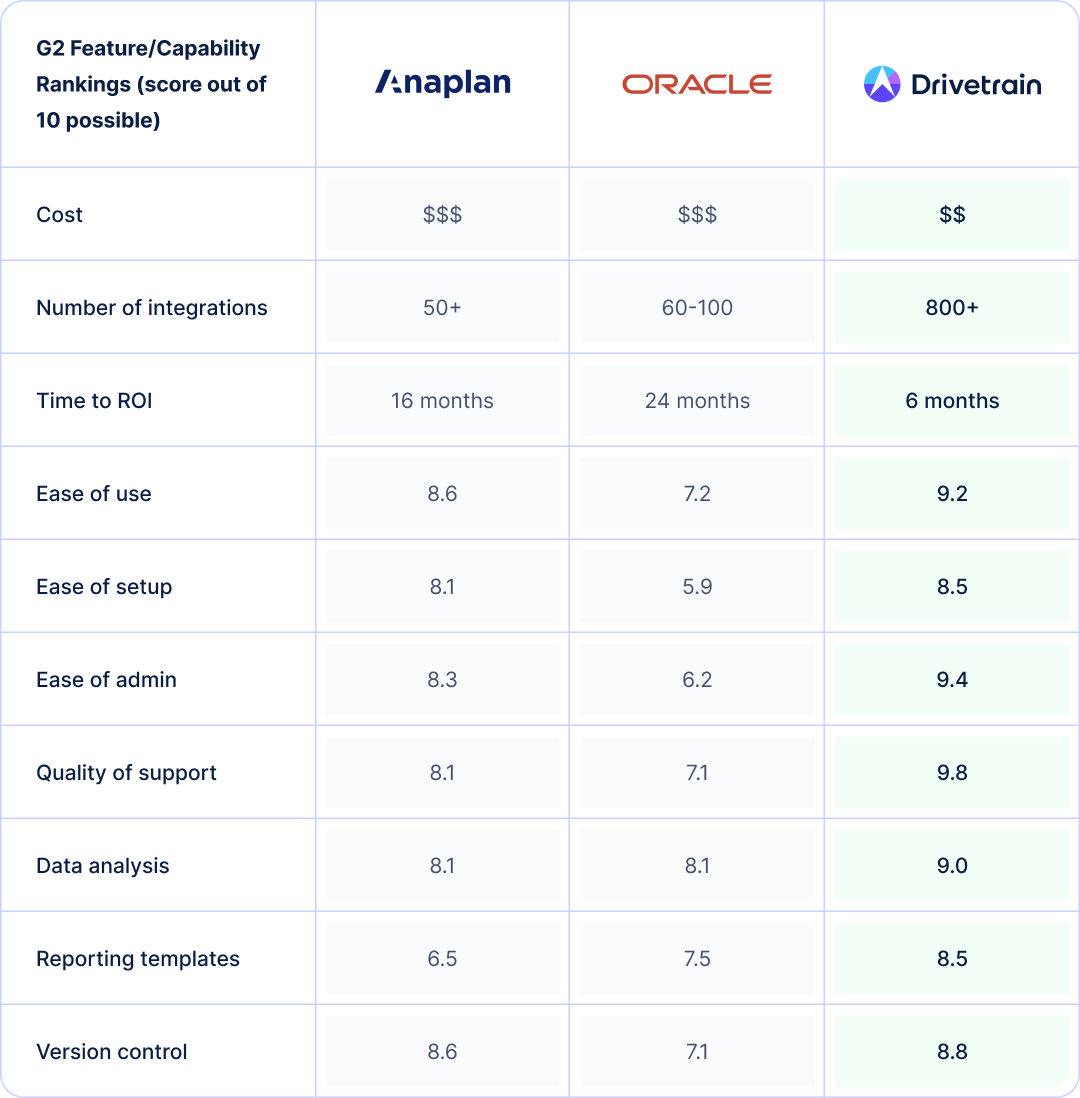
Drivetrain’s self-serve approach and its modern architecture is also reflected in its implementation timeframe, which can get you up and running in just 4–6 weeks as opposed to the 6–7 months, minimum, that Anaplan and Oracle EPM require.
Anaplan, Oracle EPM, and Drivetrain can all rightly be described as AI-powered FP&A platforms. However, the relative usability of their AI features differs based on how they’ve incorporated AI into their platforms.
Drivetrain offers native AI capabilities, meaning they were built into its core architecture based on a vision of autonomous finance. This approach is notably different from that of Anaplan, Oracle EPM, and other legacy platforms built decades before the beginning of the current “AI Era.”
Rather than rebuild, they had to layer AI capabilities on top of their complex legacy architecture. Not surprisingly, both Anaplan and Oracle EPM user reviews reveal that, while their AI features appear to be robust, they remain largely inaccessible due to their complexity and the heavy data operations required to use them.
In comparison, Drivetrain’s AI features are equally robust, but they’re also easily accessible to users throughout the platform. For example, finance teams can instantly transform their data for modeling and explore their data, and get answers to their questions in seconds using simple conversational prompts. These are just a few examples of the native AI capabilities features built into Drive AI.
Drivetrain fully enables finance-owned FP&A with all the planning and modeling capabilities enterprise finance teams need today and robust AI features, all accessible without deep technical expertise.
Seamless integrations and real finance agility
Drivetrain simplifies data integration with more than 800 native, plug-and-play connectors that finance teams can install and configure themselves in minutes, completely eliminating any need for custom middleware or development.
Easy integration, combined with AI data transformation, significantly streamlines multi-ERP consolidation and provides automated data flows to reduce latency. And, ML-based anomaly detection ensures instant notification of potential data issues that can impact models and reports.
Unlike Anaplan and Oracle EPM, which undermine the agility of finance teams with complex integrations that require deep technical expertise, Drivetrain creates agility and eliminates fragility with integrations that finance teams can easily install and manage themselves.
A powerful, yet flexible platform designed with the user in mind
Legacy vendors trade usability for capability, but Drivetrain focuses on delivering a clean, finance-first UX that balances power with clarity. Users consistently highlight faster review cycles, simpler dashboards, and much less manual reconciliation work.
On G2, reviewers say “One of the standout features of Drivetrain is its intuitive interface. It's incredibly user-friendly, making it easy for both finance professionals and non-finance stakeholders to navigate.” and “Drivetrain is intuitive, easy to use, and very flexible.”
In addition, Drivetrain’s practical approach to AI ensures that it is easy to use and provides real benefits for finance teams, speeding up specific high-value tasks like data normalization, anomaly detection, and draft narrative support.
With a simple conversational prompt, users can get instant answers to questions on how to use Drivetrain in context throughout the platform, making it feel like a natural extension of the finance team and even easier to adopt.
A decision framework for CFOs
Choosing the right FP&A platform is a strategic decision that impacts how your finance team operates long-term. Instead of focusing on feature lists and vendor rankings, you must first assess your organization’s needs to pick a platform that adapts as you scale.
The following step-based framework can help CFOs make an informed decision when selecting an FP&A platform:
- Assess current state: Organizations upgrading from Excel face different adoption challenges than those migrating from another enterprise platform. Understanding your starting point shapes realistic expectations for change management, training requirements, and the pace at which your team can absorb new capabilities.
- Evaluate complexity: Fast-growing companies need platforms that scale as entities, currencies, and business units multiply. Organizations with active M&A need systems that can quickly integrate new companies without requiring a full re-implementation.
- Understand implementation velocity and ownership: Consider your organization's capacity for change alongside vendor timelines. It's important to know who is responsible for ongoing modeling, whether your finance team, IT department, or third-party consultants. Slow implementation or reliance on technical admins is often the biggest long-term bottleneck.
- Validate integrations and data flow: Look beyond connector lists to verify whether the platform integrates cleanly with your existing ERP, CRM, HRIS, data warehouse, and BI tools without middleware. Confirm data refresh frequency, mapping flexibility, and who will maintain these integrations day-to-day.
- Stress-test modeling performance and use cases: Ask vendors to run a proof-of-concept using your dimensionality, business logic, and sample historical data. Measure calculation speed, model refresh times, and concurrency under load.
- Assess AI explainability and auditability: AI is only useful if finance can trust it. Ask the vendor for examples of narrative outputs (e.g., reports, forecasts, etc.) that are traceable and auditable, and to explain how their models source data, handle bias, and produce recommendations.
- Estimate a three-year TCO: Include expected services spend, model rebuilds, integration maintenance, admin overhead, additional modules, training needs, and potential price increases upon renewal.
- Review vendor partnership and support quality: You're committing to a multi-year partnership where support quality, product roadmap alignment, and vendor stability materially impact your success. Request references from customers at a similar scale and complexity to evaluate the vendor’s customer success model.
Choosing your FP&A partner
Anaplan can be a good choice for complex enterprises that need connected planning across multiple teams, can accommodate longer implementations, and have the budget for implementation support and the ongoing technical expertise needed to maintain the system.
Oracle EPM can work well for companies that require a comprehensive EPM software to provide strong governance, control, and auditability, and have a mature IT team and/or the funds needed for external consultants to help manage it. For enterprises using other Oracle tools, Oracle EPM is a good way to leverage those investments.
However, the complexity inherent in both Anaplan and Oracle EPM gets in the way of many enterprise finance teams, often preventing them from effectively doing their jobs. This is the very real impact of legacy systems, which by design, control and constrain finance teams by requiring IT intervention for things that most need and want to do on their own.
Enterprise finance teams today are dealing with rapid planning cycles, diverse data sources, limited administrative resources, and a growing demand for automation. Drivetrain delivers all the power and FP&A capabilities that enterprises today need, along with a level of agility that neither Anaplan nor Oracle EPM can match.
Drivetrain is designed for finance-owned FP&A, for finance teams who want to own their own models and administration, without relying on IT or external consultants. It's for companies that value seamless integrations with their existing tech stack and one that can just as easily accommodate any new systems they might need as they grow.
Its simplicity and AI-driven automation provide the control and auditability that fast-growing finance teams need, and the platform's intuitive interface allows for easy data input and manipulation, giving users full control over their financial data.

Want to see what finance-owned FP&A looks like in real life? Book a demo and see for yourself how Drivetrain’s FP&A platform empowers modern finance teams.

Rama Krishna is a Strategic Finance Partner with over 13 years of experience in FP&A and business finance across SaaS, eCommerce, FMCG, and pharma. He led FP&A functions at Amazon (Consumer and Wholesale entities), managed P&L as Category Finance Partner at Amazon, and built business finance operations at L'Oréal and Cloudtail. At HighRadius, he served as Senior Director of Business Finance before joining Drivetrain. Rama leverages his extensive experience to write about scenario planning, best practices in business budgeting, and financial planning strategies for high-growth companies.
FAQs
How do Anaplan and Oracle EPM compare in terms of AI features?
Anaplan and Oracle EPM are both AI-powered FP&A software. Anaplan’s PlanIQ enhances forecasting and anomaly detection but still requires clean data, careful model validation, and hands-on tuning from analysts. Oracle EPM’s AI is heavily dependent on structured data, proper configuration, and significant setup effort. Neither delivers the practical AI benefits many CFOs hope for, and some users report that the AI features remain underutilized.
In contrast, Drivetrain’s native AI features are easily accessible throughout the entire platform, making them more usable for day-to-day finance operations. Drive AI includes features embedded in FP&A workflows to accelerate data prep, automate forecasts, and generate draft narratives, without requiring data scientists or extended model training cycles. Natural language query allows finance users to ask questions in plain English and receive formatted analyses. Predictive forecasting uses models specifically tuned to seasonality, headcount changes, and expense trends, providing clear outputs that finance teams can trust.
How easy is it to migrate off Anaplan or Oracle EPM to Drivetrain?
Migration from legacy FP&A or EPM platforms is rarely simple. Anaplan and Oracle EPM users report challenges around data extraction, model recreation, dependency mapping, and rebuilding integrations from scratch. Without clear guidance, migrations can become slow, expensive, and disruptive.
Drivetrain tackles these migration challenges with a dedicated Customer Success Manager (CSM) and migration specialists with finance expertise. They help you reconstruct your planning models in Drivetrain's environment, leveraging your existing model documentation and business logic and provide structured processes for extracting, validating, and loading historical data while maintaining integrity and audit trails.
Drivetrain also offers technical assistance for running in parallel with your legacy platform for validation with automated reconciliation tools to quickly identify any discrepancies. With its proven implementation playbook, Drivetrain is able to get most customers fully migrated in just 4–6 weeks.
What are the main differences between Anaplan and Oracle EPM for mid-market vs. enterprise CFOs?
For enterprise CFOs, both Anaplan and Oracle EPM offer deep capabilities, but they come with trade-offs. Anaplan excels in multi-dimensional planning and cross-functional collaboration, but it requires dedicated technical expertise for building models and maintaining the system. Oracle EPM provides a robust EPM software that supports financial planning, consolidation, close, taxes, and financial reporting, but that breadth often comes with longer implementations, heavier IT dependency, and higher ongoing ownership costs.
Mid-market CFOs, as well as some enterprises, will struggle with the overhead required to run either system. Lengthy implementation cycles, reliance on consultants, integration friction, and steep learning curves can overwhelm lean finance teams.
Drivetrain, on the other hand, delivers enterprise-level power but is flexible enough for both mid-market and enterprise teams to deploy, own, and operate without technical specialists. Whether you're a $50M company scaling rapidly or a $500M enterprise seeking agility, Drivetrain provides the power and sophisticated FP&A capabilities you need without the complexity.
Why is integration a chronic pain point with Anaplan and Oracle EPM?
Both platforms struggle with integration because they were developed with older technologies and a level of complexity that doesn't align well with the hybrid tech stacks most enterprises use today.
Drivetrain has developed a vast integration ecosystem capable of meeting the needs of modern enterprises with 800+ native data connectors. Finance teams can set up data flows through guided workflows in minutes as opposed to waiting weeks for an IT team or external consultants to install and configure them.
What are the biggest complaints about implementation with Anaplan vs. Oracle EPM?
Implementation pain dominates user reviews for both platforms, with timeline overruns and cost creep as the most consistent complaints. Anaplan implementations average 6+ months, and model building requires advanced modeling expertise, custom data integration, and significant change management to ensure adoption.
Oracle EPM implementations can take seven months or more. Its modular architecture requires you to configure multiple interconnected applications simultaneously, each with its own learning curve and technical requirements. The consultant dependency creates both timeline and cost challenges for both platforms.
Organizations that want to get up and running quickly should evaluate Drivetrain, which offers a 4-6 week implementation timeline and transfers ownership to finance teams from day one. Its pre-built templates accelerate setup, and guided configuration eliminates all IT dependency. Finance teams own their models and can make changes independently without expensive external dependency.


.webp)