.svg)
.svg)
.png)
Worried if AI will take over your job? You don’t need to, and in this guide, we explain why. We dive deeper into areas where AI is likely to dominate and areas where humans are and will remain essential. We also look at ways to make yourself future-proof in the AI Era.
.svg)
.svg)

.svg)

AI is transforming almost every industry, including finance. Our State of AI in FP&A study found that “curiosity is turning into action,” with more than 80% of the FP&A professionals surveyed now using AI in their workflows. And the rest indicated plans to do so in the near future.
With the speed at which AI adoption is happening in business as a whole, it’s likely that a lot of finance professionals have one question in common:
Will AI take over finance jobs?
It’s a legitimate question for some. AI is being increasingly used to handle repetitive tasks across many areas of business today, including the finance function. Therefore, finance professionals who have thrived primarily based on their spreadsheet skills will need to level up to remain competitive.
It’s not all doom and gloom, though. AI isn’t here to replace financial professionals. It’s here to augment their work—to speed up your financial workflows and free up your time for tasks like strategic decision-making, which still requires a human mind.
Think of AI as the world’s fastest junior analyst. It’s tireless and accurate (with proper oversight), but still needs your judgment to turn insights into action.
In this guide, we explore this evolving balance between AI and humans in finance. We look at what work AI will automate first, the human skills that will remain irreplaceable, and how you can future-proof your financial career in the AI Era.
Why this question matters now
Anxiety over AI isn’t new for finance teams, but it has never felt this real. Drivetrain’s report shows that over just the past 2–3 years, finance leaders have transitioned from being cautiously curious to rapidly adopting AI in finance.
Indeed, according to Gartner’s 2024 AI in Finance Survey, AI adoption increased sharply from 39% of finance functions involving some component of AI in 2023 to 58% in 2024. Results from its 2025 survey show a slight increase, suggesting that while the speed of adoption may be slowing, it’s still growing.
Over the last couple of years, several use cases for generative AI in finance have emerged. Not surprisingly, a more recent McKinsey survey indicated that 44% of the CFOs surveyed reported using generative AI in at least five different ways in 2025.
That survey also found that finance departments are quickly adopting AI, and CFOs are increasing tech budgets, even as they freeze headcount.
This rapid expansion of AI into the finance function is exactly why finance professionals are wondering what the future holds.
What finance work will AI automate first?
AI has already automated basic tasks like data entry and reconciliations, and its ability to execute more advanced tasks is quickly growing.
AI-native FP&A tools like Drivetrain are able to automate more advanced tasks, including variance analysis and commentary, baseline forecasting, and management reporting. As AI continues to evolve, it will be able to perform even more complex tasks.
However, while the work of finance teams is evolving, too, it’s not going to go away. For one thing, many finance teams are still in the early stages of their own AI evolution, piloting AI use cases or just starting to scale those that have been proven. So far, AI success has been a mixed bag for many organizations.
Will AI eliminate finance jobs?
Many of the tasks once handled by entry-level analysts, data prep, reconciliations, and basic modeling are increasingly being absorbed by AI.
But this doesn’t necessarily point to the AI-driven extinction of finance jobs—it is leading instead to job dissection. Finance roles are increasingly being examined in terms of the individual tasks they require. The goal here is to hand off repetitive tasks to AI, freeing up more time for finance professionals to focus on higher-value work, such as strategy and tasks that require human intellect and discernment.
With that in mind, the real question isn’t whether AI is going to take over your role—it’s whether you know how to use it to augment your high-value (and uniquely human) capacity and skills.
For example, if your current role involves simple yet time-consuming tasks such as reconciliations and data entry into spreadsheets, consider upskilling to learn how to utilize AI to perform the same work more efficiently.
Simultaneously, you should lean more into the strategic aspects of your role. For example, if you are responsible for creating financial reports for your company, you could use AI to provide the data analysis and format the report so you can spend your time instead reviewing it and providing the commentary.
What AI can’t replace: human judgment and strategic thinking
AI is brilliant at crunching numbers, but it doesn’t understand business. It can detect anomalies in your forecast variance, but it can’t tell your CEO whether now’s a good time to double down on a particular product line. That’s where you need an experienced human.
Another reason AI can’t replace humans is accountability. For example, AI can help you crunch numbers or summarize a long transcript, but you still can’t let it make decisions independently because you can’t hold it accountable.
AI-driven automation will change your job description, but it won’t eliminate the need for a human in those roles. In companies that have adopted AI in finance, teams are evolving toward AI-augmented workflows that revolve around human judgment. Storytelling and critical thinking—both uniquely human—will become even more important.
The future of finance belongs to professionals who can use AI to amplify their skills and value in the workplace.
Evolving roles and skills for FP&A in the AI-Era
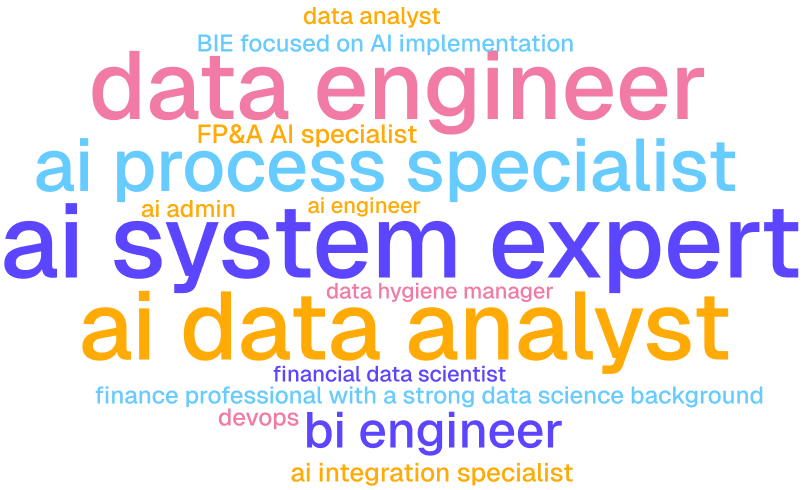
For our State of AI in FP&A report, we asked finance leaders, "If your team had to hire one new role in 2026 to stay ahead in an AI-powered future, what would it be?"
We found that many finance leaders see a growing need for hybrid roles that blend finance fluency with technical expertise:
- AI Process Specialists: Experts who understand how AI integrates into financial processes and can guide automation strategy.
- Data Engineers: Professionals who can build, clean, and optimize datasets to fuel accurate forecasting and modeling.
- AI Systems Experts: Individuals who understand how to configure, maintain, and govern AI platforms used across finance.
- AI Data Analyst: Someone who can interpret complex data sets and drive insights using AI tools.
These findings make intuitive sense—as AI increasingly takes over tasks like data prep, reconciliations, and basic modeling, the role of finance professionals will evolve. As a result, finance teams in the future will likely look different from those of today.
What are the core skills finance professionals will need?
AI will reshape finance teams, not eliminate them. It’s clear that FP&A will be transformed not only through AI tools but also with human talent.
Here are four core skills that every finance professional will need to stay on the leading edge of that transformation:
1. Data literacy
Data literacy means understanding where your numbers come from, how they flow through systems, and what can go wrong along the way.
For finance teams, this requires knowing how to interpret model outputs and analyze data pipelines, tracing data from source systems like ERPs, CRMs, and HRIS through every transformation layer into reports and models. You won’t need to have an in-depth knowledge of standard query language (SQL), but you should be able to read a query, spot a filtering error, and know how to figure out report discrepancies.
2. AI literacy
AI literacy means understanding what AI tools can and cannot do, how to use them effectively, and how to critically evaluate results.
For finance teams, this starts with recognizing that LLMs generate plausible text based on patterns—not verified facts. For example, they can produce variance commentary that sounds right but cites the wrong driver. Likewise, ML forecasting models learn from historical patterns and struggle with unprecedented events unless you provide context.
Understanding these limitations will help you choose the right tool for each task. It will also help you set appropriate expectations with stakeholders (e.g., framing an AI-generated forecast as “directionally useful” instead of a commitment).
Developing your judgment, or the ability to recognize when an AI output requires deeper scrutiny before using it in a report or informing decision-making, is another key component of AI literacy.
3. Prompt engineering
Prompt engineering is communicating with AI models to get accurate and useful outputs. Given the speed of AI adoption in finance, for finance professionals, prompt engineering is becoming as important as fluency with Excel.
Note that AI literacy and prompt engineering go hand-in-hand. To develop effective prompts—the kind that produce useful, accurate outputs—you need to know how to choose the correct type of model for the task. Even with the most expertly crafted prompt, the output you get will not be reliable if you’ve chosen the wrong type of model.
4. Model governance and ethics
Governance and ethics are critical to ensuring that AI-assisted decisions are explainable, auditable, and fair. In finance, AI outputs can inform capital allocation, headcount decisions, investor communications, and regulatory filings. The stakes are high, and errors can carry very real consequences.
Governance starts with documentation. It’s about creating an audit trail for every AI workflow. AI audit trails are important both for SOX compliance and diagnosing problems when something goes wrong. Ethics is about ensuring transparency when the use of AI can influence decisions that can affect people, and maintaining accountability.
A 90-day AI upskilling plan for finance leaders
Professionals who learn to work with AI are the ones who will thrive now and in the future. As NVIDIA CEO Jensen Huang rightly points out, “You're not going to lose your job to an AI, but you're going to lose your job to someone who uses AI.”
So, here's a plan to help you get up to speed on AI in finance in just three months.
Month 1: Build foundational AI literacy
- Get hands-on immediately: Start by using LLMs like ChatGPT, Claude, or Copilot in everyday finance tasks like drafting variance commentary, explaining metrics to non-finance stakeholders, and building scenario assumptions. As you begin to get comfortable with these tools, you can upgrade your tech stack with automation tools like n8n and Replit to build out custom agentic workflows. Take a look at the tools you already use in your day-to-day work. They might have new AI features you can experiment with to build your skills.
- Learn effective prompting: Master prompting with consistent practice. Run daily prompt experiments, observe the output, and identify areas where you can provide additional guidance to enhance it. Build a prompt library for recurring tasks and refine your prompts based on what works. You can start right now—watch our free masterclass on ChatGPT for FP&A, download our 14 Essential AI Prompts for Finance professionals, and go from there.
- Understand the fundamentals: Read 2-3 explainers on how LLMs work in general, and look at the documentation for any particular LLMs you’re interested in using. Key topics to focus on include understanding how models are trained and how training data can impact their results, AI hallucinations, and why AI sometimes confidently gives wrong answers.
Month 2: Develop finance-specific AI judgment
- Run structured experiments: Each week, test AI on different finance tasks, such as creating a forecast commentary, board deck narratives, and sensitivity analysis. Evaluate the outputs and track which ones were usable as-is versus those that needed heavy editing or were completely unusable.
- Learn AI’s limitations: Push the boundaries and evaluate the results not only in terms of their reliability but also their value. Where does the AI add real value? Where does it miss important business context only you know?
- Learn from other AI practitioners working in finance: Join an online community where finance professionals are sharing real AI experiences to get insight into what’s working and what isn’t. Subscribe to newsletters that focus on AI in finance to stay on top of new use cases, new developments, and trends.
Month 3: Learn about AI governance
- Study AI governance frameworks: In Month 1, you will have learned a bit about "explainability" and "auditability" in AI. Now it’s time to gain a deeper understanding of what these terms mean specifically in the context of finance. Look for examples of finance-specific governance frameworks and best practices for AI governance to get started.
- Practice auditing your AI workflows: Pick one AI workflow and trace the logic to the end result. Document the full audit trail, from the original data source, the model and prompt used, the output, to the reviewer and final decision-maker. Can you explain to your CFO or auditors why the AI reached that conclusion? Where would you need human verification before presenting to the board?
- Document your decision rules: Create a framework for determining the level of oversight AI workflows will require. Which finance tasks can AI handle with light review? Which ones need deeper review and audits? Which tasks should never be automated? This framework will help you ensure the limitations inherent in AI don’t impact your reports and decision-making.
AI won’t replace finance teams; they’ll make them better
AI won’t make finance professionals unemployable. They’ll just change what finance professionals spend their time on.
Instead of manually punching numbers into a spreadsheet, AI allows you to spend more time thinking about the story those numbers tell and how you think they will impact your business.
Nobody knows exactly how quickly AI will morph over the next few years. But one thing is certain: If you don’t learn how to use AI, you’ll be left behind.
If you’re ready to take charge of your career and committed to keeping your business at the leading edge of your industry, explore Drivetrain to see what an AI-native FP&A platform can really do.

Kirk Kappelhoff is a financial modeling expert with a BBA in Finance & Accounting and nearly a decade of experience at Deloitte, EY, and KPMG, where he built models for pre-IPO companies, M&A transactions, and strategic planning initiatives. At KPMG, he led the Business Modeling Services team, specializing in equity stories and financial forecasts that help high-growth companies communicate their value to investors. At Drivetrain, Kirk writes about strategic planning, granular reporting, and modern FP&A best practices for rapidly scaling finance teams.



.webp)