
Annual Recurring Revenue (ARR)
Learn what annual recurring revenue (ARR) is, including how to calculate it, key types, benchmarks, and how it compares to revenue and other SaaS metrics.
 Alok Goel, CEO/CFO & Co-founder
Read TL;DR
- Annual recurring revenue or ARR represents the yearly value of a company's recurring revenue from subscriptions. It's a crucial metric for tracking business growth, customer retention, and sales performance.
- There are six different types of ARR and each provides a unique insight into the health of your business - new, expansion, renewal, churned, contraction, and resurrected ARR.
- Companies should benchmark their ARR growth rate against other companies of their size and maturity (refer to this section for benchmarks).
- Revenue and ARR are not the same. Revenue is a GAAP metric that measures the amount of money coming into your business (from subscriptions, services, and any one-time fees). Whereas ARR only accounts for subscriptions.
Annual recurring revenue (ARR) is a common topic at SaaS board discussions and provides the starting point for most SaaS financial planning and analytics (FP&A) projections. However, it can be easy to confuse ARR in the SaaS context with a couple of other financial metrics that share the same acronym (“annual run rate” and “accounting rate of return”). So, let’s clarify.
Definition
What is ARR? In the SaaS context, ARR is the recurring revenue from subscriptions, normalized over a period of one year. Given its “recurring” context, a SaaS company’s ARR captures revenue only from subscriptions.


In this article, we’ll discuss why ARR is an important metric for SaaS companies, the different types of ARR you need to know, and how to calculate them. We’ll also look at how ARR differs from generally accepted accounting principles (GAAP) revenue.
Why is ARR such an important metric for SaaS companies?
1. A leading indicator you (and your potential investors) can use to track momentum
While it primarily reflects current contract revenue, in the SaaS world, ARR is a core metric that boards and investors use to evaluate a company’s prospects for success. SaaS companies can use it to set forward growth targets and sales quotas. ARR is also useful for capacity planning, for which your existing ARR can be used to calculate a new, forward-looking ARR target.
In fact, ARR provides the basis for several KPI-based SaaS planning processes and projections and plays a key role in the valuation of SaaS companies. Investors track ARR trends to determine valuation multiples (the ratio of a company’s ARR and its valuation) during funding rounds. As a momentum or leading SaaS metric, SaaS ARR intuitively gives stakeholders an idea of which way the company is headed.
2. Helps you proactively correct course if needed
ARR is useful for estimating your year-end revenue, which can help you proactively identify problems that need fixing.
For instance, if your actual ARR lags your projections, you can dive deeper into your go-to-market (GTM) team’s performance to investigate any issues.
3. Provides insights into different areas of business
There are six different types of ARR that are crucial for SaaS decision making because they offer insights into several aspects of your business, including sales, customer success and satisfaction, and a customer’s lifetime value (LTV).
Some of the different types of ARR seem very similar, offering slightly different ways of looking at performance. However, they’re all interrelated, and by combining them in different ways, you can gain a much deeper understanding of your SaaS business finances.
The 6 types of ARR you must know and why
Here are the different types of ARR you must know and why they matter.
1. New ARR – This is ARR generated from new subscriptions, which helps you assess how well you’re on track with your new business development. It is the total ARR from new customers. As such, it is sometimes also referred to as “New Logo ARR” or “New Business ARR”.
2. Expansion ARR – This is ARR gained from subscription upgrades via upsells and cross-sells, which tells you the impact those efforts specifically are having on your revenue. Calculating and then drilling down into what is driving your expansion ARR can help you improve it and other metrics as well. For example, the additional revenue from expansion ARR increases the lifetime value (LTV) of your customers and your net retention rate (NRR). And, because selling more services to existing customers doesn't add to your customer acquisition cost (CAC), it also improves your LTV:CAC ratio—a key indicator of your sales efficiency.
3. Renewal ARR – This is ARR generated from renewed subscriptions. For SaaS companies, the subscription model provides the basis for business growth. Renewal ARR (also known as Retention ARR) is a predictor of customer satisfaction. It’s also an indicator of future growth because it represents your ability to deliver long-term value to your customers, which helps to generate more revenue without adding to your CAC.
4. Churned ARR – This type of ARR measures the revenue lost from customers canceling their subscription or choosing not to renew (the logo is lost). Churned ARR can indicate a number of things. Churn can be an indicator of customer satisfaction. For example, an increasing number could mean your customers aren’t happy with some aspect of your product, something you might be able to address. Or, it could be that the customer has simply found a cheaper alternative.
5. Contraction ARR – This type of ARR represents any type of reduction in what the customer was previously paying, which could include plan downgrades, one/more canceled licenses or seats, or usage-based reductions. (Contraction ARR should not be confused with “Contracted” ARR, which reflects contractually guaranteed annual recurring revenues.)
6. Resurrected ARR – ARR gained from subscribers who canceled subscriptions but signed back up during the time period. Resurrected ARR (also known as Reactivation ARR) can indicate a couple of different things. Reaching out to your resurrected customers to find out why they came back is a good idea because it can reveal insights into what it might take to win back previous customers.
How to calculate ARR
You can calculate ARR by summing the following individual metrics:
- Revenue earned from new subscriptions (New ARR)
- Revenue earned from subscription upgrades (Expansion ARR)
- Revenue earned from existing subscription renewals (Renewal ARR)
- Subtract revenue lost from canceled subscriptions (Churned ARR)
- Subtract revenue lost from downgraded subscriptions (Contraction ARR)
Here is the standard formula to calculate ARR for your SaaS business:
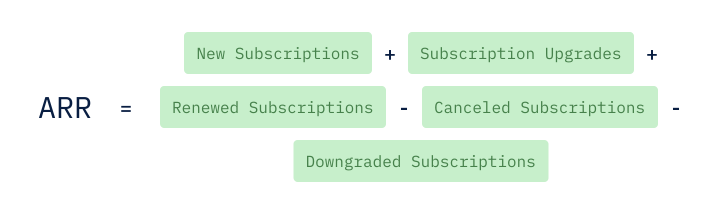
Formula for calculating ARR.
Here’s an example ARR calculation
Let’s see an example of how you can calculate your company’s ARR. In this example, our company has the following:
New ARR = $5M
Expansion ARR = $2M
Retention ARR = $3M
Churned ARR = $1M
Contraction ARR = $1M

Example calculation of a SaaS company ARR.
Alternatively, you can calculate ARR by multiplying your monthly recurring revenue (MRR) by 12. MRR is the revenue you earned from subscriptions over the course of a calendar month. Note, that any annual contract payment included in your ARR will need to be divided by 12 and spread out over the entire year to get an accurate MRR with this method.

Formula for calculating ARR using MRR.
Here’s an example of how you can calculate ARR using MRR. In this example, our SaaS company has an MRR of $700,000:

Example calculation of ARR using MRR.
ARR vs. MRR
MRR is generally more useful for early-stage or usage-based SaaS companies where revenue fluctuates significantly month over month.
ARR is ideal for companies with longer-term contracts, and it’s commonly used for strategic planning, board reporting, and valuation.
Most SaaS companies use both to track recurring revenue for different purposes.
| When to Use ARR vs. MRR | |
|---|---|
| ARR | MRR |
| Fundraising conversations: Investors use ARR multiples for benchmarking and valuations. | Day-to-day growth tracking: Reveals momentum month-to-month and catches churn and expansion signals early. |
| Annual goal-setting and planning: Matches the natural cadence of budgets, headcount plans, and revenue targets. | Operational planning: Aligns revenue to monthly cost obligations like headcount and infrastructure. |
| External credibility: A headline number for recruiting, enterprise sales, and market positioning. | Comparing mixed contract types: Normalizes monthly, annual, and multi-year contracts into one number. |
What is a good ARR?
Generally speaking, it’s hard to find reliable benchmarks for ARR because ARR growth rate offers a better measure of velocity, momentum, and future potential than any fixed revenue number.
However, we did find some data on median ARR based on a company’s age in SaaS Capital’s 2025 Private B2B SaaS Company Growth Rate Benchmarks report. The median ARR values in the table below are approximated from the information in Figure 6 of the report.
| What is a good ARR? | |
|---|---|
| Company age | Median ARR |
| Year 1 | ~$250K |
| Year 2 | ~$500K |
| Year 3–4 | ~$1M–$2M |
| Year 5–6 | ~$3M–$4M |
| Year 7–8 | ~$6M–$7M |
| Year 9–10 | ~$8M–$10M |
| Year 10+ | ~$10M–$12M |
These numbers get us a little closer to answering the question, “What is a good ARR?” But there’s an important caveat here for using them as benchmarks for your business. The values reported in the study reflect median ARR reported from all the companies surveyed, blending the results for bootstrapped companies together with those that are equity-backed.
The report notes that equity-backed companies grow significantly faster (and therefore accumulate ARR faster) than bootstrapped ones, especially for those at the under-$5M ARR stage. So, if your company is equity-backed, the median ARR shown in the table will likely understate where your well-funded peers might be sitting.
So maybe the better question is, “What is a good ARR growth rate?”
How to calculate ARR growth rate and interpret the results
ARR growth rate measures how quickly your recurring revenue is increasing year over year. It reflects the combined impact of new customer acquisition, expansion revenue, and retention performance.
It also provides context that absolute ARR can’t. For example, a company with $5M ARR growing at 100% is might be viewed as more attractive than a $10M company growing at 10%. This is because the growth rate shows momentum and future potential. These are factors investors prioritize heavily when investing in a SaaS.
Here’s how to calculate ARR growth rate:
ARR growth rate = (Current ARR - Previous ARR) / Previous ARR * 100
Given the heavy emphasis on growth in the SaaS industry, it’s not surprising that many studies have attempted to determine ideal SaaS growth rates. We’ve provided results from a few of them here. The most common way of reporting ARR as a growth metric is by grouping companies into ARR revenue bands. Some provide ARR growth as a range, while others provide a median or the top quartile (75th percentile).
The ARR growth rates in the figure below were reported in the SaaS Capital study referenced above and illustrate that, while ARR and company age are directly correlated, ARR growth rate and company age are inversely correlated. In other words, older companies have higher ARR, but they grow more slowly.
However, the report attributes much of the difference in growth rates to the “denominator effect” used in the growth rate calculation. This happens when dividing by a small base number (i.e., the lower ARRs used to define smaller companies), which can produce large percentages, even from modest absolute gains.
The denominator problem: why growth rates naturally decline as you scale
Maintaining a high ARR growth rate becomes difficult as your company grows because it’s calculated as a percentage of your existing revenue base. When that base is small, even modest gains translate into high growth rates.
For example, growing from $500,000 to $1M in ARR represents 100% growth. But growing from $10M to $15M results in just 50% growth, despite a much larger absolute increase.
This is why early-stage companies often report triple-digit growth, while more mature companies see growth rates decline over time. Of course, this doesn’t indicate weaker performance. It simply reflects the math behind percentage-based growth.
This dynamic is critical to understand before you benchmark your performance against peers. Remember, a lower growth scale can still represent strong execution, especially when it’s accompanied by meaningful increases in absolute ARR.
ARR growth rate benchmarks
Benchmarkit's 2025 B2B SaaS Performance Metrics Report reveals the following ARR growth benchmarks, based on company stage:
- Less than $1M ARR: 100%
- $1M–$5M ARR: 45%
- $5M–$20M ARR: 27%
- $20M–$50M ARR: 15%
- $50M–$100M ARR: 10%
- Over $100M ARR: 6%
The most current data from High Alpha provides global benchmarks for SaaS companies with less than $1M in ARR to more than $50M, and suggests that the median represents “good” ARR growth and that companies in the 75th percentile are achieving “great” growth.
| ARR Growth Rates | |||||
|---|---|---|---|---|---|
| Company size (by ARR) | < $1M | $1M – $5M | $5M – $20M | $20M – $50M | > $50M |
| Median | 100% | 50% | 31% | 30% | 16% |
| Range (25th percentile to 75th percentile) | 29–300% | 24–100% | 15–72% | 16–41% | 10–29% |
Below are the most current YoY ARR growth benchmarks reported by ICONIQ. They reflect ARR growth for the companies in the top quartile (75th percentile). The data for this study was drawn from both public SaaS companies and ICONIQ’s private venture and growth portfolio.
Like the other studies, ICONIQ’s results show the same pattern: smaller companies appear to grow faster than larger ones. However, the report also noted that, while established startups (those older than one year) show very high growth rates in the early years, they begin to stabilize around year 10.
| ARR Growth Rates | |||||||
|---|---|---|---|---|---|---|---|
| Company size (by ARR) | < $10M | $10M – $25M | $25M – $50M | $50M – $100M | $100M – $250M | $250M – $500M | > $500M |
| YoY ARR growth | 515% | 170% | 105% | 90% | 60% | 50% | 60% |
How ARR compares to other revenue-related metrics
ARR is one of the most widely used metrics in SaaS, but it loses its effectiveness without sufficient context. To fully understand your company’s performance, you must compare it with other revenue-related metrics, especially those grounded in accounting standards or focused on retention and profitability.
Each metric answers a different question. ARR shows the annualized value of your recurring revenue, while other metrics like retention rates and profitability KPIs provide additional context on how that revenue is recognized and sustained.
ARR vs. revenue
Revenue is the total value of income earned from delivering all goods or services, while ARR accounts for just subscriptions. Revenue is a generally accepted accounting principles (GAAP) term, which applies to money coming into your business from services that have, for the most part, already been rendered. In contrast, ARR is not. A SaaS company can earn revenue through the following channels:
- Revenue from subscriptions
- Revenue from consulting fees
- One-time payments such as installation and onboarding fees
GAAP revenue is the sum of these three items, while ARR is just the first. As a result, ARR is often lower than total revenue. However, it can exceed recognized revenue depending on contract structure and timing.
The following table illustrates the major differences between ARR and revenue:
| ARR | Revenue | |
|---|---|---|
| What it represents | Annualized value of recurring subscription revenue at a point in time. | Total revenue recognized from all goods or services delivered during a given period. |
| How it's used | Used for strategic planning, forecasting, and valuation benchmarking. | Reported for auditing, financial reporting, and tax purposes. |
| Nuances | Non-GAAP metric; excludes non-recurring revenue and normalizes contract value to an annual basis. | GAAP-recognized; includes both recurring and non-recurring revenue. |
ARR vs. contracted ARR
ARR and contracted ARR represent different views of your revenue. ARR reflects the recurring subscription revenue your business is currently generating, normalized to a one-year period. It typically includes only active subscriptions and excludes revenue from contracts that have not yet started.
Contracted ARR (CARR), on the other hand, represents the total value of recurring revenue that has been contractually committed, regardless of whether the contract has started. This can include future-dated contracts or signed agreements that will begin generating revenue in future periods.
The differentiating factor here is timing.
ARR shows revenue you’re earning today, while contracted ARR provides a forward-looking view of revenue that’s already secured but not yet realized. Because of this, contracted ARR is often higher than ARR and is commonly used for forecasting and pipeline visibility, while ARR is used for reporting current performance.
| ARR | Contracted ARR | |
|---|---|---|
| What it represents | Annualized value of recurring subscription revenue from active contracts at a point in time. | Annualized value of recurring revenue under signed contracts, including future start dates and often adjusted for known future changes (e.g. churn or downgrades). |
| How it's used | Used by investors for current-state valuation and benchmarking. | Used by investors and sales leaders to assess forward revenue visibility and bookings momentum. |
| Nuances | More conservative as it reflects only live, billing subscriptions. | Typically higher; includes contracted but not yet active revenue and may include forward adjustments. |
ARR vs. deferred revenue
ARR is a non-GAAP operational metric that measures active, ongoing revenue in your business. Deferred revenue is a GAAP accounting concept that represents cash you’ve already collected for services you haven’t delivered, distinguishing between revenue actually earned vs. future revenue. It appears as a liability on your balance sheet until revenue is recognized over time.
The key difference lies in timing and recognition.
Let’s say you’re a SaaS company that sells a two-year subscription for $24,000 with annual billing of $12,000.
When your customer pays $12,000 upfront the first year, that $12,000 is recorded as deferred revenue. As you deliver the service each month, $1,000 is recognized as revenue, and the deferred revenue decreases by the same amount.
At the end of the first year, the deferred revenue will be $0, and ARR will remain $12,000. When the customer pays $12,000 for year two, the deferred revenue will “reset” to $12,000, and the pattern will repeat, with deferred revenue decreasing by $1,000 each month as services are delivered.
In contrast, the ARR for that contract will remain constant at $12,000 for the life of the active subscription because it doesn’t reflect any concept of revenue recognition, only the revenue from active contracts.
A somewhat subtle nuance here is that while monthly subscribers contribute to ARR, that revenue carries little or no deferred revenue because they pay month-to-month. So for businesses with a mixed customer base, the two figures can look very different for structural reasons beyond just timing.
| ARR | Deferred Revenue | |
|---|---|---|
| What it represents | Annualized snapshot of recurring subscription revenue at a point in time. | Amount of cash collected for goods or services (may be recurring or non-recurring) not yet delivered, recorded as a liability. |
| How it's used | Non-GAAP metric used for forecasting, benchmarking, and investor reporting. | Used for GAAP-compliant financial reporting and balance sheet analysis. |
| Nuances | Normalizes recurring revenue to a 12-month period regardless of billing cadence. | Fluctuates based on billing timing (e.g., prepaid contracts can increase deferred revenue). |
ARR vs. NRR
Unlike ARR, net retention revenue (NRR) focuses specifically on how your existing customer base is performing over time. It measures how much recurring revenue you retain from existing customers, including the impact of expansion and churn, but excluding any new customers.
The difference between ARR and NRR is one of perspective—how you want to evaluate your revenue. ARR represents your total recurring revenue, while NRR isolates the growth or decline within your current customer base.
For example, a company with 120% NRR is generating more revenue from its existing customers than it started with, even after accounting for churn and downgrades. This may indicate strong product value and expansion opportunities. On the other hand, ARR alone doesn’t reveal much about whether your revenue growth is coming from new customers or existing ones.
| NRR | ARR | |
|---|---|---|
| What it represents | Percentage of beginning-period ARR retained from existing customers after expansions, downgrades, and churn; excludes new customers. | Annualized value of recurring subscription revenue at a point in time. |
| How it's used | Used to evaluate revenue quality, expansion efficiency, and cohort-level retention trends. | Used to measure overall business scale and growth. |
| Nuances | Can exceed 100% when expansion revenue outpaces churn and contraction. | Can grow despite churn if new customer acquisition offsets losses. |
ARR vs. GRR
ARR and gross retention revenue (GRR) answer different questions. ARR shows your total recurring revenue at a point in time, while GRR isolates the stability of your existing customer base.
ARR includes all sources of recurring revenue, including new customers, expansions, renewals, churn, and contractions to give you a comprehensive overview of the revenue base and overall growth.
GRR focuses only on how much revenue you retain from existing customers over a given period. So, it excludes expansion revenue and accounts only for losses due to churn and contraction.
For example, a company can grow ARR through strong new sales and upsells, even if it’s losing revenue from existing customers. GRR helps uncover this by measuring how much of your starting revenue is retained before any expansion.
ARR and GRR are complementary metrics—ARR tells you how fast you’re growing, GRR tells you how well you’re retaining and whether growth is sustainable in the long term.
| GRR | ARR | |
|---|---|---|
| What it represents | Percentage of beginning-period ARR retained from existing customers after downgrades and churn, excluding expansion. | Annualized value of recurring subscription revenue at a point in time. |
| How it's used | Used to assess baseline customer retention and product stickiness. | Used to measure overall business scale and momentum. |
| Nuances | Capped at 100% because expansion revenue is deliberately excluded; a high GRR suggests the core product holds its value. | No ceiling; can grow through new logos and upsells even when underlying retention is weak. |
ARR vs. EBITDA
ARR is a top-line metric. It shows how much predictable revenue your business is generating. On the other hand, earnings before interest, taxes, depreciation, and amortization (EBITDA) measure profitability. It accounts for both revenue and operating expenses to show efficiently that your business is generating earnings.
Both of them focus on different things. ARR tells you how much recurring revenue you have, while EBITDA tells you how much of that revenue translates into profit. Because of this, a company can have a high ARR but low (or even negative) EBITDA if it’s investing heavily in growth through sales, product development, etc.
This means you can use ARR to track growth and forecast revenue, but to evaluate operational efficiency and financial health, you need to look at EBITDA.
| ARR | EBITDA | |
|---|---|---|
| What it represents | Annualized value of recurring subscription revenue (top-line metric). | Earnings before interest, taxes, depreciation, and amortization (profitability metric). |
| How it's used | Common basis for valuation multiples in high-growth SaaS (e.g., EV to ARR). | Common basis for valuation in mature or cash-flow-positive businesses. |
| Nuances | Does not reflect cost structure, margins, or profitability. | Reflects operational efficiency but excludes capital structure and non-cash expenses. |
ARR vs. revenue run rate
ARR is based only on contracted, predictable revenue streams and excludes one-time or non-recurring income.
Revenue run rate is an extrapolation of your current revenue over a given period, typically calculated by taking figures of a recent month or quarter and projecting them forward over a year.
The difference lies in what’s being annualized.
ARR annualizes only recurring subscription revenue, while run rate annualizes total revenue based on recent performance. Unlike ARR, run rate may include non-recurring revenue.
Think of a company that generates $1M in revenue in a quarter. Its annualized run rate would be $4M. But if a portion of that revenue comes from one-time deals or services, the run rate would overstate the company’s predictable revenue base. ARR, by contrast, would include only the recurring portion of that revenue.
For this reason, ARR is considered more reliable when assessing predictable revenue and long-term performance, while run rate is more useful for quick estimates.
| ARR | Revenue Run Rate | |
|---|---|---|
| What it represents | Annualized value of recurring subscription revenue only. | Annualized projection of total revenue (recurring and non-recurring) based on a shorter period. |
| How it's used | Standard SaaS metric for benchmarking and valuation. | Used to extrapolate short-term performance into an annual estimate. |
| Nuances | More stable and predictable as it excludes variable revenue. | Can be volatile depending on timing and inclusion of non-recurring revenue. |
ARR vs. gross ARR vs. net ARR
Because ARR reflects the annualized value of recurring revenue at a specific point in time, it offers a snapshot of recurring revenue that already reflects the cumulative effects of churn, contraction, and expansion.
Gross ARR and net ARR can lend more detail to the recurring revenue picture by showing what’s happening within a given period, depending on how they’re defined.
Gross ARR generally refers to recurring revenue before churn and contraction are factored in for a given period. It’s useful for evaluating sales performance and gross revenue momentum, but it overstates realized recurring revenue because it doesn’t account for losses during the period.
It’s important to note that gross ARR is not a standardized metric and can vary by company. Depending on how a company defines it, it may refer to the starting ARR for a period or to the total value of recurring revenue additions before losses are factored in.
Starting ARR is simply the ending ARR from the prior period carried forward. It's the baseline before anything happens in the current period (i.e., no new bookings, no churn, no expansion). So it provides a clean opening balance.
When companies define their gross ARR as the total recurring revenue additions before losses, it means they’re adding up all the new and expansion ARR generated during the period (and in some cases, renewals), without subtracting churn or contraction. Defined in this way, gross ARR can actually be higher than starting ARR because it's stacking new activity on top without subtracting anything.
There’s no right or wrong definition. The difference just means it’s important to know how a company defines gross ARR in order to accurately interpret it.
Net ARR isn’t standardized either. It’s typically defined as the recurring revenue remaining after churn, contraction, and expansion are accounted for. It usually aligns with ending ARR for a period. Since it reflects how much revenue the business actually kept for the period, it’s useful for assessing retention and revenue durability.
To sum it up, gross ARR shows recurring revenue before losses are applied, net ARR shows recurring revenue after all the changes are apple, and ARR shows the recurring revenue base at a specific point in time.
| ARR | Gross ARR | Net ARR | |
|---|---|---|---|
| What it represents | Annualized value of recurring subscriptions at a point in time (typically reflects net ARR after churn and contraction). | Total ARR before accounting for churn and contraction within a given period. | ARR remaining after accounting for churn and contraction over a defined period (often equivalent to ending ARR). |
| How it's used | Standard shorthand for recurring revenue in investor communications and valuation. | Used to analyze gross ARR movements, including new bookings before losses. | Used to measure realized ARR after losses and for retention analysis. |
| Nuances | Reflects current recurring revenue position. | Does not reflect realized ARR; excludes the impact of churn and contraction; definitions may vary by company. | Reflects true ending ARR after accounting for losses. |
SaaS ARR reporting
Tracking and reporting ARR is about understanding what’s driving the changes you see in your recurring revenue over time.
Most SaaS companies use an ARR waterfall (or ARR bridge) to track how ARR moves between reporting periods. An ARR waterfall breaks down changes in ARR into the key components (e.g., new ARR, expansion ARR, renewal ARR, churned ARR, and contraction ARR).
This means an ARR waterfall report helps you see the drivers behind any growth or decline in revenue. Here’s how waterfall reports help:
- Reveal whether growth is coming from new customers, expansion, or pricing
- Qualify the impact of churn and contraction
- Detect “revenue leaks” that may not be obvious from top-line ARR alone
- Build more accurate forecasts using historical revenue movements
Click on the video below to see what a waterfall report looks like.
To make your waterfall reports actionable, make sure you use a consistent ARR definition in terms of what it includes and how it’s calculated. Break it out by product, segment, or anything else you believe is important to see what’s driving your ARR. Then, track movements regularly to identify trends in churn or expansion early.
How technology simplifies ARR analysis and tracking
If you have a relatively simple pricing model for your SaaS, such as a price based on the number of licenses sold, then tracking your ARR may be relatively straightforward.
However, tracking ARR becomes much more challenging with the more complex pricing models increasingly prevalent in the SaaS industry today. Such models use a combination of pricing factors for which the data resides on different platforms and is difficult to consolidate.
The best way to track ARR is to use a financial reporting software or a comprehensive FP&A platform that can connect your ARR and other SaaS metrics into your financial planning processes and make reporting easier.
Both types of software significantly streamline ARR analysis and tracking with automated waterfall charts that are always up to date and robust reporting capabilities, including revenue reporting dashboards, to give you a more holistic view of your business.
ARR is a core SaaS metric that plays a critical role in financial projections. Tracking it on an ongoing basis is key to unlocking powerful insights that you can leverage for faster growth.
About the author

Alok Goel
CEO/CFO & Co-founder
Alok Goel is Co-founder and CEO/CFO of Drivetrain, the AI-native business planning platform for modern finance teams. He holds an MBA in finance and brings deep financial expertise from over five years as a Partner at Elevation Capital, where he led venture investments in high-growth companies, rigorously evaluating business models, financial projections, and unit economics at scale. Alok also served as CEO of FreeCharge, where he executed India's largest M&A in the Indian internet space, and held leadership roles at RedBus as Chief Operating Officer and Chief Product Officer. Earlier in his career, he spent over five years at Google, leading product management for Google Display Network and heading search and mobile products.
FAQs
What does annual recurring revenue (ARR) mean in SaaS?
ARR is the recurring revenue from your SaaS business’ subscriptions, normalized over a period of one year. Given its “recurring” context, ARR captures revenue only from subscriptions.
ARR is an important metric that forms the basis for several SaaS projections. Also, investors take ARR into account during funding rounds when valuing a SaaS company.
Why is ARR different from revenue?
Revenue is the sum of all the cash generated from sales in your business while ARR accounts for just subscriptions. Also, revenue is a generally accepted accounting principles (GAAP) item while ARR is not.
If your SaaS offers other services like consulting, those will be included in total revenue, but not ARR.
How is ARR calculated?
Here is the formula for calculating ARR:
ARR = New Subscriptions + Subscription Upgrades + Renewed Subscriptions - Canceled Subscriptions - Downgraded Subscriptions
SaaS professionals also express the ARR formula as:
ARR = New ARR + Renewal ARR + Expansion ARR - Churned ARR - Contraction ARR
Why is ARR important for SaaS companies?
ARR is important for SaaS companies because it:
1. Forms the basis for further analysis by FP&A and RevOps teams
2. Offers a direct way to track subscription sales
3. Offers insights into churn, retention, and customer LTV
What is a good ARR for my company’s stage?
There’s no universal benchmark. ARR varies by company, size, funding, and market. That’s why most SaaS companies typically benchmark ARR growth rate rather than absolute ARR. For example, companies with less than $1M in ARR may aim for 100% or more ARR growth, while companies above $20M may only need to grow 20–30% to be considered strong performers. As companies scale, growth rates naturally decline due to the larger revenue base.
What is the difference between ARR and contracted ARR?
ARR represents the annualized value of active, recurring subscription revenue your business is currently generating. Contracted ARR (CARR) includes all signed recurring revenue commitments, even if the subscription hasn’t started. This can include future-dated contracts or ramp deals. In short, ARR reflects current performance, and CARR provides a forward-looking view of secured revenue.
What's the difference between ARR, revenue run rate, and GAAP revenue?
ARR, revenue run rate, and GAAP revenue each measure revenue differently:
- ARR includes recurring subscription revenue (annualized).
- Revenue run rate extrapolates recent revenue (including non-recurring) over a year.
GAAP revenue reflects revenue recognized according to accounting standards, including one-time and service-based income.
NRR vs. ARR: what is the difference?
ARR is an absolute dollar figure representing the total annualized value of active recurring subscriptions. It’s used as a measure of overall business momentum.
NRR is a percentage that shows how much of that recurring revenue a company retains and from its existing customers over a given period, after accounting for upgrades, downgrades, and churn. It’s used to assess how efficiently a company grows and holds onto the revenue it already has.
Explore more related metrics
View allBillable Utilization
Billable utilization, also known as utilization rate, measures the percentage of an employee's available time spent on revenue-generating activities.
Billings in SaaS
Billings is the total value of invoices issued to customers for subscription services over a specific period, reflecting both new and existing customer commitments. It includes the timing, frequency, and methods for collecting payments from customers.
Bookings in SaaS
Bookings, also known as sales bookings or committed revenue, refers to the total “committed” value of all new contracts signed within a specific period, representing future revenue that a company “expects” to recognize, including recurring and non-recurring revenue commitments.
Bookings vs. billings vs. revenue
Bookings, billings, and revenue are key financial metrics in SaaS, representing different stages of a sale. Bookings (or total contract value) show committed sales, billings are invoiced amounts, and revenue is the earned portion. These metrics are vital for assessing financial health and forecasting.
Burn Multiple
The burn multiple measures how much capital your SaaS company spends to generate $1 of new annual recurring revenue (ARR). Created by Craft Ventures co-founder David Sacks, it measures how efficiently your company converts its spending into ARR. The lower your burn multiple, the less your company is spending to grow.
CAC Payback Period
CAC Payback Period is the time it takes a company to recoup the money it spent to acquire a customer.
Become the strategic partner your business needs.
Fewer spreadsheets, faster planning, better decisions.