
Monthly Recurring Revenue in SaaS: What it is, how to calculate it, and the different types of MRR
Monthly recurring revenue or MRR is a key SaaS metric. Learn what it is, how to calculate MRR with examples.
 Alok Goel, CEO/CFO & Co-founder
Read TL;DR
- MRR is a vital SaaS metric that indicates the total predictable monthly revenue from active subscriptions. It excludes one-time payments, trials, discounts, and coupons. Click here to see how to calculate it.
- By understanding MRR, you can track revenue growth, forecast ARR, improve financial planning, and optimize business strategies.
- You can track eight types of MRR: New, Retention, Expansion, Churned, Contraction, Resurrected, Committed, and Net New MRR to get insights into customer satisfaction, growth potential, and revenue leakage.
- If your SaaS business adds $400,000 in New MRR but ends up with a total MRR of $390,000, it indicates revenue leakage. For every $400,000 gained, $130,000 is lost due to the high churn of $70,000 and a contraction of $60,000. Fixing churn and improving product-market fit can fix the Leaky Bucket scenario.
- Double-digit MRR growth is ideal, with 15-20% growth rates considered strong for startups aiming for rapid scaling.
- Curious to learn how you can use MRR as a SaaS metric to model your revenue? Download this free eBook.
Monthly Recurring Revenue (MRR) is one of the most important metrics for any SaaS company because it can help you analyze many different aspects of your business. In this article, we’ll explore how you can calculate MRR and the insights it can provide, along with some examples. But first, let’s start with a definition:
Definition
What is MRR in SaaS? MRR or Monthly Recurring Revenue is the sum of the predictable or confirmed revenues your company earns from active subscriptions every month. It excludes one-time payments and only accounts for recurring revenues.


Why is MRR an important metric for SaaS companies?
MRR is a key metric for SaaS companies because it provides the basis for deeper KPI-based SaaS financial planning. Here are a few reasons why you must track MRR.
1. MRR can be used to calculate your annual recurring revenue (ARR)
SaaS company valuations depend on their annual recurring revenue (ARR), which is a leading indicator for momentum. Multiplying MRR by 12 gives you the ARR for your company, which is a key metric for evaluating SaaS company performance. For instance, SaaS company valuations depend on ARR, and boards use the previous year’s ARR to set new ARR targets.
Tracking MRR also helps you figure out where you’ll land by the end of the year and feeds into several SaaS financial planning and analytics (FP&A) models.
2. MRR gives you a snapshot of your current revenue
MRR gives you a snapshot of where your revenue currently stands. Tracking MRR trends and changes in the different types of MRR (mentioned in the next section) will help you figure out what you need to address in your business. For instance, a dip in new business MRR tells you your sales team or product needs work to bring new customers in.
3. Crucial for financial planning
MRR, along with ARR, serves as the basis for many SaaS decision making processes. MRR also feeds into your monthly close workflows, giving you insights into cash flow and other important financial metrics.
4. Offers insights into different areas of SaaS your business
The different types of MRR help you figure out what’s lacking in your business and where you need to devote resources. For instance, rising contraction MRR indicates potential problems with your product’s features or decreasing product to market fit.
The 8 types of MRR
There are different elements of MRR that can be calculated. Each of these types provides insights into what is working and not working in your business.
- New MRR – This is MRR generated from new business. This helps you track your appeal to new customers. It’s also called “new logo MRR” or “new business MRR.”
- Retention MRR – This is MRR generated from renewed subscriptions. This number helps you understand the value you’re delivering to your existing customers. Retention MRR (also known as Renewal MRR) is a predictor of customer satisfaction. It’s also an indicator of future growth because it represents your ability to deliver long-term value to your customers, which helps to generate more revenue without adding to your CAC.
- Expansion MRR – Expansion MRR includes the purchase of add-ons or additional seats and upgrades to higher tiers or increased consumption if you have a usage-based pricing model. Companies capture this revenue through upsells and cross-sells. Prioritizing expansion MRR is a great way to boost revenue without increasing CAC.
- Churned MRR – This is MRR lost due to subscription cancellations. Churn is a good indicator of customer satisfaction. Investigate the issues behind churn and you’ll receive a good picture of what your product lacks and what your customers want.
- Contraction MRR – This is MRR lost from subscription downgrades. Contraction MRR includes subscriptions that are paused or downgraded to lower-priced plans, and the cancellation of any recurring add-ons. If you offer a customer a discount or credits, those are included as part of Contraction MRR as well.
- Resurrected MRR – This is the MRR generated from subscriptions who canceled but then signed up with you again. Resurrected MRR is also sometimes referred to as “Reactivation MRR”.
- Committed MRR – Committed MRR (CMRR, pronounced “see-mer”) is a forward looking metric that indicates the MRR a company expects to earn based on contract commitments. Committed MRR is also sometimes referred to as “Contracted MRR”.
- Net New MRR – Net New MRR is the increase or decrease in the current month’s MRR compared to the previous month. Net New MRR is a volatile number, given its monthly focus. However, you can correlate it with new marketing and sales campaigns as a way of measuring how effective they are.
How do you calculate your MRR?
You can calculate MRR by summing the following:
- Revenue earned from new subscriptions (New MRR)
- Revenue earned from subscription upgrades (Expansion MRR)
- Revenue earned from existing subscription renewals (Retention MRR)
- Subtract revenue lost from canceled subscriptions (Churned MRR)
- Subtract revenue lost from downgraded subscriptions (Contraction MRR)
Here is the formula for calculating MRR:
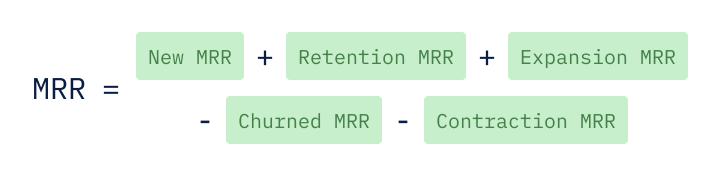
MRR = New MRR + Retention MRR + Expansion MRR - Churned MRR - Contraction MRR
Example MRR calculation
Let’s illustrate how you can calculate your company’s MRR:

Example calculation of a SaaS company MRR. New MRR = $2M; Expansion MRR = $1M; Retention MRR = $4M; Churned MRR = $200,000; Contraction MRR = $100,000; MRR = $2M + $1M + $4M - $200,000 - $100,000 = $6.7M
A few tips to remember when calculating and tracking your MRR
When you’re calculating your MRR, make sure you’re not including the wrong data:
- Exclude trials – MRR includes predictable or confirmed revenue. Trials are neither. For example, monthly revenues from a customer that has signed a contract will almost certainly arrive in your bank account. However, someone who has signed up for a trial (even if it is paid) may not upgrade their subscription, thus making this revenue stream less reliable.
- Exclude discounts and coupons – Always deduct the value of discounts and coupons when calculating MRR since these represent a reduction in subscription amounts. They are considered part of your Contraction MRR.
- Exclude non-recurring revenue – MRR does not include revenues from implementation fees, hardware fees, and non-subscription activities like consulting.
If your subscription model isn’t monthly, you’ll also need to normalize your calculation for recurring revenue to a 30-day period to get your MRR. This is pretty straightforward with annual and quarterly subscription models.
For an annual subscription model, you would simply divide your ARR by 12. Likewise with a quarterly subscription period, you would divide your quarterly recurring revenue by four.
Normalizing your recurring revenue calculation to MRR becomes a bit more complicated when your subscription period is measured in weeks or days. While Drivetrain handles this type of calculation easily, you can use the same variables in the MRR calculation above to calculate an MRR for any time period over which you have data.
Once you’ve calculated your MRR, you’ll want to pay close attention to each individual component of the metric, analyzing how it may be impacting the total MRR. This will help you understand the full picture of your company’s health.
Also, don’t treat MRR as an accounting number. MRR is not a generally accepted accounting principles (GAAP) number. Therefore, you should not report it for accounting or tax purposes.
What is a good SaaS MRR growth rate?
There is no single “good” MRR growth rate since it varies depending on your company’s maturity and revenue model. MRR is a useful metric, however focusing solely on MRR to track your growth is not a good idea because it is sensitive to the effects that seasonality or temporary market disruptions have on your business.
While most growth rate studies focus on ARR (since it’s more stable compared to MRR,) a few MRR-based studies exist. Back in 2014, Veteran VC Tomasz Tunguz of Redpoint indicated that post-seed, pre-Series A startups must target a 15-20% MRR growth rate.
Tunguz arrived at this conclusion by laying out the following assumptions:
- Estimated capital raised at seed - $1M
- Estimated capital raised in Series A - $5M
- Percentage equity sold at seed - 15%
- Percentage of equity sold in Series A - 20%
- Implied valuation at seed - $6.7M
- Implied valuation at Series A - $25M
- Time from seed to Series A - 9-10 months
Extrapolating this data, we can conclude that a company must increase MRR by 15-20% to achieve its goals. However, Tunguz’s assumptions are a bit dated, even if they largely hold true in the current VC landscape.
Jason Lemkin, Founder of SaaStr and veteran VC, offered a more recent answer. Lemkin notes that double-digit MRR growth is a benchmark for every company that has gained traction. 15% is great while 20% is an outlier.
Ultimately, a “good” MRR growth rate boils down to your growth goals, traction in the market, and current maturity.
How to analyze MRR – an example
MRR trends can reveal actionable insights into your SaaS business. Here’s a simple example illustrating how the different types of MRR can reveal gaps in your business.
Let’s assume our SaaS company has the following numbers:
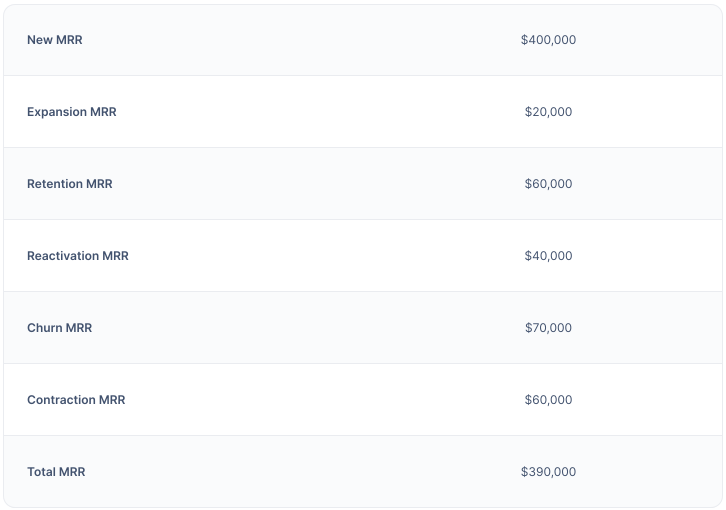
Our SaaS company has a healthy New MRR number of $400,000. However, our total MRR is $390,000. At $70,000, our churn is also higher than our Retention MRR of $60,000. And at $60,000, our Contraction MRR is three times higher than our Expansion MRR of $20,000.
One possible interpretation of this data is that we need to focus more on product quality or product market fit. Despite getting plenty of new customers each month, we’re clearly having trouble keeping some of our customers (commonly referred to as the Leaky Bucket scenario).
Based on our high Resurrected MRR, which reflects revenue from customers who canceled their subscriptions but came back, we can assume that our competition in the market is relatively low. So, if we can improve our churn and contraction by addressing product issues, our SaaS can capitalize on that lack of competition and grow faster.
Admittedly, this is a simplistic analysis. However, it shows how the different types of MRR can lead you deeper into your business, revealing different insights that when combined, can lead to additional insights that you can leverage to improve your business.
How Drivetrain simplifies MRR analysis?
Using MRR as a basis for further projections is challenging due to the processes many FP&A teams rely on. Spreadsheets and business intelligence tools have their uses but are not customized to fit FP&A or the specific needs of Revenue Operations (RevOps) teams.
Spreadsheets are inflexible and not built for modern SaaS FP&A needs. Using them for complex financial analyses requires building highly elaborate formulas, which are prone to human error. Business Intelligence (BI) tools offer historical snapshots but you can’t use them to answer the “what-if” types of questions needed to support planning and analysis (e.g. “If I increase my advertising budget by 20%, what would the impact be on my revenue?”).
Drivetrain is a purpose-built revenue forecast software for simplifying the FP&A process with a familiar interface where you can:
- Automate data sourcing, build reports and dashboards in an Excel-based interface.
- Drill-down from summary to transaction data to quickly identify drivers that impact revenue goals and answer follow-up questions.
- Automate calculation and consolidation of financial and SaaS metrics, cash flow and sales projections.
Calculating MRR with all its nuances is a challenging task. Presenting it in a way so that people can make the right decisions is even harder. With the right tool, you can extract actionable insights from MRR to drive your business forward.
About the author

Alok Goel
CEO/CFO & Co-founder
Alok Goel is Co-founder and CEO/CFO of Drivetrain, the AI-native business planning platform for modern finance teams. He holds an MBA in finance and brings deep financial expertise from over five years as a Partner at Elevation Capital, where he led venture investments in high-growth companies, rigorously evaluating business models, financial projections, and unit economics at scale. Alok also served as CEO of FreeCharge, where he executed India's largest M&A in the Indian internet space, and held leadership roles at RedBus as Chief Operating Officer and Chief Product Officer. Earlier in his career, he spent over five years at Google, leading product management for Google Display Network and heading search and mobile products.
FAQs
Is MRR better than ARR?
No. Neither is better than the other. MRR and ARR are both snapshots of your business’ recurring revenues. The only difference is that MRR is calculated monthly and feeds into ARR, which is calculated annually.
MRR tends to be more volatile, but gives you short-term insights that ARR can obscure.
Why is MRR important for SaaS companies?
MRR is important for SaaS companies because of the following:
1. Feeds into ARR
2. Offers a snapshot of current revenue
3. Crucial for financial planning and projections
4. Offers insights into different elements of your SaaS business
How is MRR calculated?
MRR is calculated via the following formula:
MRR = New Subscriptions + Subscription Upgrades + Renewed Subscriptions - Canceled Subscriptions - Downgraded Subscriptions
The MRR formula can also be written as:
MRR= New MRR + Retention MRR + Expansion MRR - Churned MRR - Contraction MRR
Explore more related metrics
View allNet Income
Net income, also known as bottom line or net earnings, is the profit a company retains after subtracting all expenses, including the cost of goods sold (COGS), operating expenses, and other expenses, such as taxes and interest on any debts. Net income helps a company understand how much money the company has actually made during a specific period.
Net Promoter Score (NPS)
The net promoter score (NPS) is a customer loyalty metric that directly impacts a SaaS company's financial health and valuation. Also known as the net promoter system or net promoter index, NPS is a single-question survey tool introduced by Fred Reichheld, a partner at Bain & Company, in 2003. The metric measures customer satisfaction by asking users how likely they are to recommend a SaaS product to others on a scale of 0-10.
Net Revenue Retention (NRR)
NRR is the percentage of recurring revenue a SaaS company retains from its existing customers over a specified time period.
Pass-through Costs
Pass-through costs are expenses you incur on behalf of customers and pass them along at the time of billing, typically at or near the actual cost. In most cases, these costs are associated with third-party goods or services that are tied to a specific client or project. The primary goal of pass-through costs is reimbursement rather than value creation. While pass-through costs are typically billed at or near cost, companies may charge an explicit and separately disclosed markup or handling fee depending on contract terms.
Pipeline Coverage Ratio
Pipeline coverage ratio, or pipeline-to-quota ratio, provides sales managers with a view of how potential deals compare to their revenue targets. It’s calculated to determine how much ARR is accounted for in the unweighted pipeline compared to the new ARR goal.
Quota Attainment Rate
Sales quota attainment (also known as quota achievement rate or sales goal attainment) measures the percentage of sales targets achieved by sales representatives or teams within a specific period. Quota attainment helps companies evaluate individual and team performance, forecast revenue, and optimize their sales strategy.
Become the strategic partner your business needs.
Fewer spreadsheets, faster planning, better decisions.