
General and Administrative as a Percentage of Revenue (G&A%)
Learn how to track and manage G&A expenses to assess your company’s cost efficiency and operational maturity.
 Jaco Schoeman, Associate Director, Strategic Finance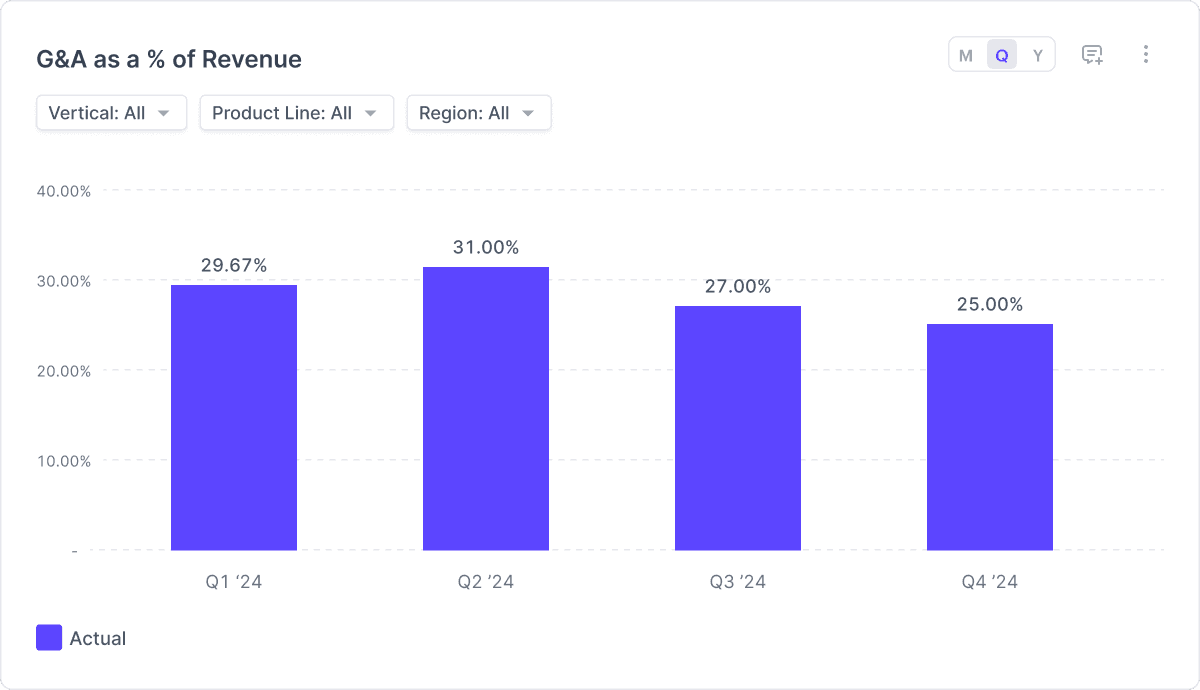
Read TL;DR
- G&A functions are the backbone of your operations. While finance, HR, legal, and IT don’t directly generate revenue, monitoring these G&A expenses as a percentage of revenue is vital to evaluating your cost efficiency and operational maturity.
- General and administrative (G&A) expenses as a percentage of revenue measures how much of a company’s revenue is spent on overhead costs required to keep the business operational.
- G&A expenses are a cost center for a business as opposed to a profit center. However, they are foundational to a company’s ability to run its business.
- Common G&A expenses include:
- Executive and administrative staff
- Professional services
- Office and facilities
- Information technology
- Insurance and risk management
- Corporate functions
- Compliance and regulatory work
- Depreciation of some assets
General and administrative (G&A) expenses are a category of expenses that are largely invisible to everyone except the finance team. They never show up in a board deck or a highlight reel. Yet tracking them is mission-critical, because they shape your ability to grow efficiently and maintain healthy margins.
Definition
General and administrative expenses as a percentage of revenue (G&A%) measures how much of a company’s revenue is spent on overhead costs required to keep the business operational.


Companies track G&A expenses as a percentage of revenue, among other metrics, to ensure cost discipline and operational maturity. In this guide, we explain what this means and how you can use the G&A number to extract insights about your business.
You’ll learn how to calculate G&A%, what costs are included in G&A expenses, and why this metric matters to businesses. We also look at the most efficient ways to collect data required to track G&A% in real time.
We’ll explore the topic through the lens of a SaaS business, however the information here is broadly applicable to businesses in almost any industry.
What is the role of G&A expenses in a business?
G&A expenses include the overhead required to keep your business operational.
This includes the costs of running finance, HR, legal, IT, and executive leadership functions. While these areas don’t directly contribute to revenue like sales and marketing (S&M), they’re essential for compliance, risk management, and governance.
G&A efficiency is a key lever of operating margins, especially for high-growth SaaS businesses. G&A expenses as a percentage of revenue serves as a benchmark to evaluate administrative cost discipline and compare performance with peer companies.
While S&M and R&D expenses scale with growth, G&A benefits from economies of scale. The best companies ensure G&A expenses grow more slowly than revenue and decline as a percentage of revenue over time.
What are the common G&A expenses?
G&A can include a wide range of overhead expenses. Here are the most common ones:
- Executive and administrative staff: Includes salaries, bonuses, and benefits for the CFO, legal, HR, and other administrative staff who support the business but don’t directly drive revenue.
- Professional services: Includes outsourced legal counsel, audit and tax advisors, consultants, and other external experts engaged for specialized, non-recurring work.
- Office and facilities: Includes rent, utilities, office supplies, and maintenance. These costs are often minimal in remote-first SaaS businesses, but can still be material in hybrid or HQ-heavy models.
- Information technology: Includes internal systems like ERP, HRIS, and productivity software, as well as IT support and infrastructure that keep your internal operations running.
- Insurance and risk management: Includes premiums paid for general liability, cybersecurity, directors and officers (D&O), errors and omissions (E&O), and other corporate insurance.
- Corporate functions: Includes the cost of centralized functions like accounting, finance, legal, and HR. These often overlap with executive support but are usually tracked separately for clarity.
- Compliance and regulatory: Includes the cost of SOX compliance, data privacy, tax filings, and other local and international regulations.
- Depreciation: Includes tangible assets used for general or administrative purposes, such as office furniture and staff computers; does not include assets using directly for the delivery of a product or service (e.g. servers running a SaaS platform).
Why G&A expenses are important for SaaS companies
Think of G&A functions as the operational backbone of your business. For SaaS businesses, in particular, tracking and keeping the costs associated with these functions in check is critical to your success as you scale. Let’s dig deeper into why G&A expenses are important:
- Helps scale without losing control: Even though they don’t directly generate revenue like S&M, G&A functions ensure you can scale rapidly without losing control.
- Improves governance and compliance: Strong G&A teams ensure adherence to regulatory, tax, and reporting requirements. These are especially critical for global expansion and IPO readiness.
- Signals organizational maturity: The structure and efficiency of your G&A functions reflect how well your company is prepared to handle scale and complexity.
- Helps make data-driven decisions: Advanced finance and IT systems (the cost of which falls under G&A expenses) offer live data that helps you develop more accurate forecasts and track metrics in real time.
Strategic G&A spending streamlines internal processes, eliminates redundancies, and reduces overhead drag on margins. If you can maintain slower G&A growth and faster revenue growth, your operating margins improve over time. However, strategic is the key word here. Underinvesting in functions like IT or compliance in an effort to reduce G&A spending can end up costing you more than think.
How is G&A as a percentage of revenue calculated?
G&A% is calculated by dividing total general and administrative expenses by total revenue, then multiplying it by 100.

Formula for general and administrative (G&A) expenses as a percentage of revenue.
For example, if a company with $4.5 million annual recurring revenue (ARR) spends $405,000 on G&A, its G&A as a percentage of revenue is 9%:

Example calculation of G&A as a percentage of revenue.
While S&M and R&D tend to increase as revenue grows, G&A should ideally go down, exhibiting operational leverage.
You’ve probably heard that leverage is a two-edged sword. It amplifies both profits and losses. Let’s look at this in the context of G&A.
Suppose your revenue last month was $10,000, and gross profit was $5,000. Assume you have no other expenses except paying two employees a monthly salary of $3,000 ($1,500 each). In this case, your G&A as a percentage of revenue is 30% ($10,000 / $3,000).
Next month, your revenue and gross profit are $15,000 and $7,500, respectively. Your G&A as a percentage of revenue now stands at 20% ($3,000 / $15,000). A lower G&A as a percentage of revenue, therefore, behaves like operational leverage—it increases your profit when revenue grows and decreases it when revenue shrinks.
For more context on G&A, you can also track other metrics like:
- G&A per employee: Shows how administrative costs scale with headcount
- G&A growth rate vs. revenue growth rate: Highlights whether overhead is expanding too quickly or staying under control
G&A costs can be of two types:
- Fixed costs: Rent, insurance, and staff salaries, which don’t change much with revenue fluctuations. These are the costs from which most of your operational leverage comes.
- Discretionary (semi-variable) costs: Consulting, IT upgrades, and extra administrative support, which can be dialed up or down based on growth, cash flow, or strategic priorities.
Note: SaaS businesses typically don’t have variable G&A expenses that scale directly with business activity.
Understanding your G&A cost mix is critical. Fixed costs offer continuity, stability, and economies of scale. But the discretionary layer is where you have room to optimize spend, preserve margins, and respond to market conditions.
What are the industry benchmarks for G&A spending?
This is a tough question to answer. If you look for benchmarks for G&A expenses for any business other than SaaS, you're probably going to have a hard time finding them. The reason for this boils down to the differences between how public and private companies do their financial reporting.
Public companies report selling, general, and administrative costs as a single SG&A line, with no requirement to break out the G&A portion, so it simply isn't in the filings. Because private companies aren’t required to file, benchmarks would have to come from surveys sponsored and paid for by an organization of some kind.
While there are plenty of those available for SaaS companies, funded by investors and lenders who need the data for diligence, there are comparatively few available for other industries and most are behind a paywall.
If you look for benchmarks for G&A expenses for any business other than SaaS, you're probably going to have a hard time finding them. The reason comes down to how public and private companies report.
Public companies report selling, general, and administrative (SG&A) costs as a single line, with no requirement to break out the G&A portion. So it simply isn't in the filings. Private companies don't file at all, which means any benchmark has to come from a survey someone paid to run. The SaaS industry has several, funded by the investors and lenders who need the data for diligence. There are comparatively few studies available for other industries, and most are behind a paywall.
Here’s what G&A as a percentage of revenue looks like for SaaS businesses, since that’s the data that’s most readily available.
SaaS Capital’s 2026 Spending Benchmarks for Private B2B Companies report shows that median G&A as a percentage of revenue is 15%, up from 14% the previous year.

Median G&A as a percentage of ARR for SaaS companies of different sizes (Source: SaaS Capital, 2026).
Here’s how those percentages break out across SaaS companies of different sizes in terms of dollars spent.
| ARR | Median G&A spend |
|---|---|
| < $1M | $32,500 |
| $1M – $3M | $250,000 |
| $3M – $5M | $542,000 |
| $5M – $10M | $1,235,286 |
| $10M – $20M | $2,406,120 |
| > $20M | $7,350,000 |
In addition to the size of your business, in SaaS, G&A spend also varies based on your target market. According to a recent report from ICONIQ, median R&D expenses as a percentage ARR for SaaS companies targeting SMB to mid-market sector is 35%, while median R&D spend for those targeting the mid-market to enterprise sector is 47%.
Another study by Benchmarkit shows that G&A expenses are considerably higher for private B2B SaaS companies than their publicly-traded counterparts.

G&A expenses as a percentage of revenue for private vs. public B2B SaaS companies (Source: Benchmarkit, 2025).
Benchmarking G&A expenses as a percentage of revenue in your business against similar-sized companies is still worthwhile no matter what industry you’re in because it can help you identify where you may be spending inefficiently or in excess.
It can also help you spot areas of your business where your spending isn’t sufficient to provide the operational resilience or foundation you need to support growth.
If you see significant variations between your G&A as a percentage of revenue and relevant, reputable benchmarks, that’s a good sign that you might need to take a closer look at the expenses driving that.
How to track, monitor, and control G&A expenses
There are several effective ways to track, control, and optimize G&A expenses, such as:
- FP&A tools: FP&A software is the most effective way to gain real-time visibility into your G&A spending. It enables proactive cost control, faster decision-making, and early detection of budget overruns and anomalies. Analytical capabilities also help you identify ways to optimize your G&A spend.
- Cost audits: Perform quarterly or semiannual reviews of G&A categories to find overruns or underutilized services. Look for trends across departments and use zero-based budgets where possible to hit reset on every team’s spending expectations.
- Expense approval workflows: Implement approval workflows to control discretionary spending in areas like travel, software, and consulting. These controls improve accountability and ensure all spending aligns with current priorities and budget thresholds.
- Outsourcing: Outsourcing helps reduce operating leverage. If you expect an economically volatile period in the near future or are otherwise struggling to protect margins, consider outsourcing non-core functions like payroll, bookkeeping, IT help desk, or legal admin to specialized vendors. This provides cost flexibility, access to expert talent, and frees up internal resources.
- Prevent uncontrolled ad hoc spending: Standardize remote work stipends and equipment reimbursements to control ad hoc spending. A clear policy helps align employee expectations with your budget.
- Benchmarking: Compare G&A as a percentage of revenue and per employee against comparable companies in your industry and region. Use industry benchmarks to set internal targets and justify both cost-cutting decisions and strategic investments.
- Contract negotiations: Renegotiate vendor and SaaS contracts, especially for professional services, when you have reason to believe you can get a better deal. Consolidating vendors or committing to longer terms can often unlock volume discounts and other more favorable terms.
Tracking is easier with Drivetrain
G&A expenses don’t directly drive revenue, but they’re fundamental to scaling your business with discipline and control. They support growth and help preserve operating margins.
Understanding the importance of G&A is easy. The hard part is what follows—consolidating and tracking G&A expense data in real time. Technology plays a critical role in this process. It gives your team real-time visibility into spend, automates workflows, flags inefficiencies, and supports scenario planning.

Drivetrain makes it easy to analyze your G&A and other expenses as a percentage of revenue to help you stay on track and identify opportunities to optimize your spends.
A tool like Drivetrain can empower your team to track and manage G&A alongside revenue growth and other critical metrics—automatically, in real time, and in sync with your goals. If you’re looking for a tool that can track G&A as a percentage of revenue and other critical metrics, take some time to explore Drivetrain today!
About the author

Jaco Schoeman
Associate Director, Strategic Finance
Jaco Schoeman is Associate Director of Strategic Finance with over a decade of hands-on finance experience in financial planning, budgeting, and FP&A system implementation. He spent over four years at Vena Solutions as Senior Services Solutions Manager, where he partnered with sales and services teams to scope projects, position FP&A solutions, and guide clients through software implementations. Before Vena, Jaco held finance and planning roles at Predator Ridge Resort, Caron Business Solutions, and BASF, where he managed commercial planning and forecasting cycles as Company Controller. At Drivetrain, Jaco writes about financial planning and budgeting best practices, FP&A software implementation strategies, and how finance teams can optimize their planning processes.
FAQs
Are G&A expenses fixed or variable?
Most are fixed but can also be semi-variable and fully variable (in rare cases). For example, if your software vendor requires you to pay for an additional license each time you add a user, that’s a fully variable cost (or semi-variable if there’s a fixed minimum annual fee).
What are common examples of G&A expenses?
Executive and admin salaries, rent, utilities, insurance premiums, professional services, and office supplies are common examples of G&A expenses.
What’s the difference between G&A and SG&A?
SG&A is a standard accounting term that combines selling, general, and administrative costs, where “selling” covers marketing and sales activities. G&A alone excludes direct sales expenses and focuses only on overhead costs.
How often should G&A be audited?
You should review G&A monthly or quarterly, based on your company’s size and available resources. During your review, try to identify spending creep, opportunities to renegotiate for more favorable terms, and actions you need to take to align structural maturity and growth targets.
Why is it so hard to find G&A benchmarks for industries other than SaaS?
Public companies report selling, general, and administrative costs as one combined SG&A line, so the G&A portion isn't in the filings. Private companies don't file at all, so benchmarks have to come from paid surveys. SaaS has several, funded by investors and lenders for diligence. Other industries have far fewer.
Explore more related metrics
View allGross Margin
Gross margin is the difference between the revenue generated from a software product and the cost of delivering that product (also called cost of goods sold or COGS) expressed as a percentage of the total revenue.
Gross Revenue Retention (GRR)
Gross Revenue Retention is the percentage of revenue a company retains from its customers over a defined period (usually one year).
LTV:CAC Ratio
The LTV:CAC ratio compares the average revenue you generate from your customers with the cost to acquire them.
Lifetime Value (LTV)
Customer lifetime value (LTV or CLTV), also known as client lifetime value (CLV) or lifetime customer value (LCV), measures the total revenue a business can expect to generate from a single customer account. For SaaS companies, LTV is crucial as it directly influences key business decisions around customer acquisition, product development, and growth—ultimately determining the sustainability and scalability of the business model.
Logo Retention Rate
Logo retention rate is the percentage of customers retained over time. Tracking it helps businesses know where to improve their customer service and/or product quality and develop retention strategies to increase customer retention.
Monthly Recurring Revenue (MRR)
MRR is the sum of the predictable or confirmed revenues your company earns from active subscriptions every month.
Become the strategic partner your business needs.
Fewer spreadsheets, faster planning, better decisions.