.svg)
.png)
- The power of sales capacity planning to drive growth
- The importance of continuous planning
- Why you should start now, even if your data isn’t perfect
- How to do sales capacity planning in 5 steps
.svg)
.svg)

.svg)

Introduction
The power of sales capacity planning
Sales capacity planning is a strategic financial modeling process that helps you predict your company’s ability to generate new revenue based on the number of account executives (AEs) you have and their productivity. And, it’s critical to the growth of your SaaS business.
Here’s why sales capacity planning is essential to growing your business...
- Sales forecasting – Sales capacity planning helps you more accurately predict and model your growth based on new revenue, based on the number of AEs you currently have and their productivity.
- Setting appropriate quotas – Setting quotas unrealistically high or using a one-size-fits-all approach can lead to poor morale and AE burn-out. Sales capacity planning helps you create a high-performing sales team with optimal quotas that take current productivity and ramp-up time into consideration.
- Headcount planning – Sales capacity planning provides a strong foundation for making data-driven decisions regarding headcount, which is likely the biggest cost driver in your business. Finding and filling gaps in your sales team will help you meet your ARR targets and ensure your hiring decisions pay off.
Another benefit of sales capacity planning (although somewhat less tangible) is that it helps to get your finance team and sales team on the same page and makes them both accountable for the goals set through the planning process.
This guide will walk you through an example of sales capacity planning, step-by-step, so you can start using this powerful process to grow your business faster.
Continuous Planning
Why you should never stop planning
In an industry as dynamic as SaaS, staying on top of changes in your business that can affect your growth is critical.
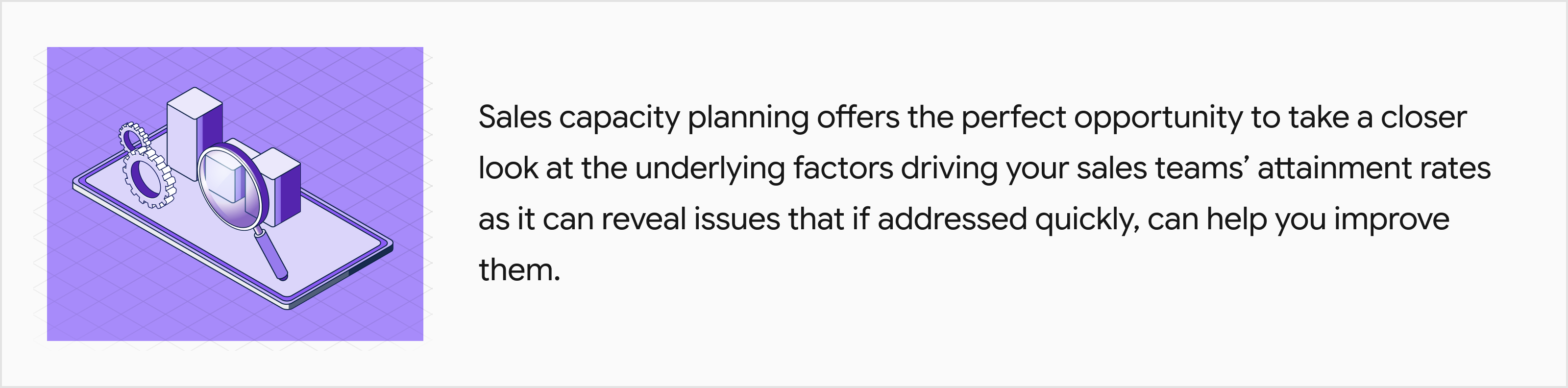
Some of your AEs are inevitably going to miss their quotas, and if you’re not keeping an eye on your sales capacity throughout the year, the possibility that you’ll miss your targets grows with every quarter.
This is why, ideally, you should look at your sales capacity and the factors that might be affecting it on a quarterly basis. The sooner you know when you’re veering off course, the more time you’ll have to adjust so you can still meet your targets.
Factors you need to consider in your sales capacity planning
Limiting Factors
Bottlenecks (and their hefty opportunity costs)
For SaaS businesses, sales capacity is a limiting factor in revenue generation. Just like in a widget factory, the number of widgets that factory can produce is limited to the number of machines it has and the continuity of its assembly line. In a factory, an assembly line has a lot of moving parts, ideally working in perfect unison to keep production humming along. But, if one of those machines breaks down, production backs up.
Sales capacity can create a similar bottleneck in your business. Let’s say you need to generate $20M this month. Your marketing team has worked with your business development representatives (BDRs) to put together a campaign that should generate plenty of sales qualified leads to hand off to your AEs to close. Problem is, you’ve just lost two of your AEs.
Even if you could fill those positions instantly, you’re still not going to be able to take advantage of all the leads you could otherwise close because your new AEs won’t be ramped up yet. If you’re not planning for sales capacity, you’re leaving money on the table.
Start Now
Sales capacity planning should be data-driven (but your data doesn’t have to be perfect)
If you’re in the early stages of your business, you might not have a lot of data to draw upon.
The more historical data you have, the more accurate your results will be. But if you’re in the early stages of your business, you might not have a lot of data to draw upon. This just means you’ll need to make some assumptions about some of the values you’ll use in your model.
Don’t let this discourage you. Sales capacity planning is critical to your company’s success. As your business grows, the amount of data you have to inform your planning will grow right along with it, making your results ever more reliable over time.
Step by step
How to do sales capacity planning in 5 steps
Step 1: Figure out your ramp-up time
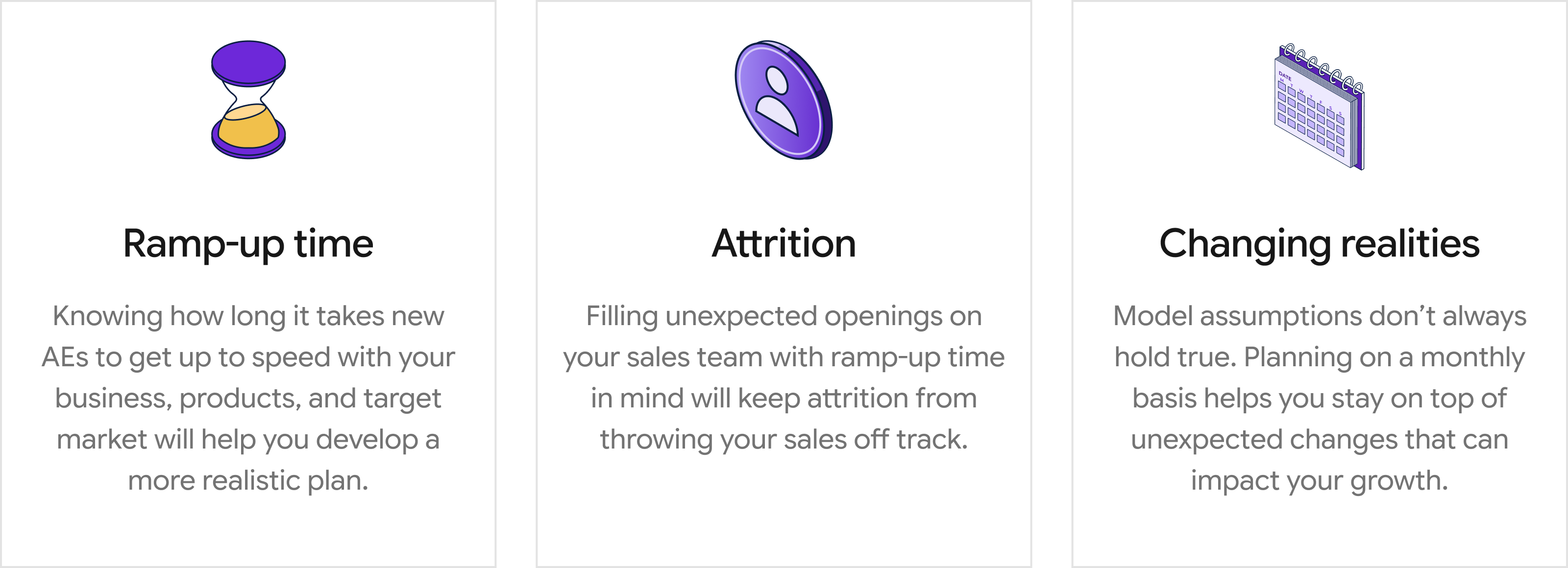
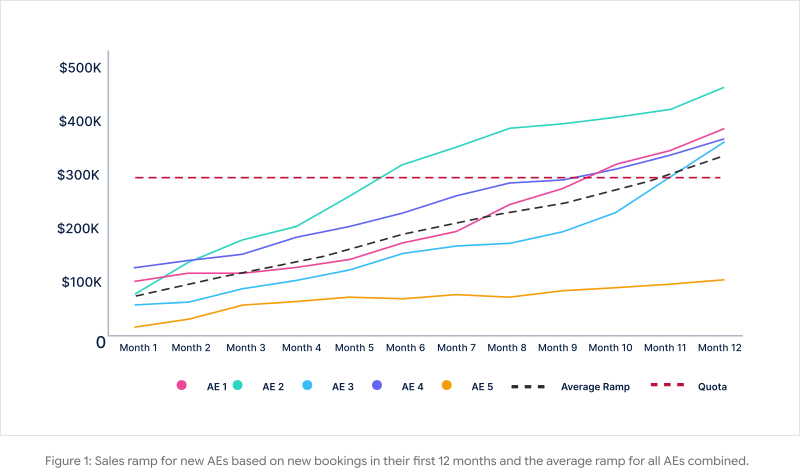
The best and most widely used method for calculating ramp-up time is to take the average time it takes your AEs to reach 100% of their quota.
By using an average, this method takes into account the fact that not all of your AEs are starting at the same place in terms of their previous experience. This fact can have a significant impact on your planning because it tells you not only how many AEs you will need to reach your targets but also when you need to hire them.
With the experience factor “baked in” as an average of known values, the result is a more accurate representation of ramp-up time. This allows you to proactively adjust the timing of your new AE hires based on when you need them to produce income.
Step 2: Determine new quotas for each of your teams
This part of sales capacity planning is pretty straightforward. You know what your ARR target is, and you know how much you need in bookings to meet it.
You probably also have some sense of which sales motions are working well for you and which ones aren’t. You can use this information to help you figure out how to allocate across the teams responsible for them.
When you allocate quotas across your teams, you’ll start by looking at their past performance. Your sales teams might be organized based on geographies, sales channels, types of customers, etc. In this example, we’ll assume we have three sales teams organized by geographic regions (Americas, EMEA, and APAC). Each of our sales teams sell into three different markets (SMB, Mid Market, and Enterprise).
Using our actuals, we can determine what percentage of the total new ARR each of these teams contributed in the past year (Table 1).
The contributions shown in Table 1 will serve as your baseline for setting your quotas. Once you have your baseline, it becomes easier to determine how much each team needs to contribute in order to meet your new ARR target.
Carrying this example to the next step, let’s say your new ARR target for the new fiscal year is 200% growth or $40M. Using the information on how much each team is currently contributing, you can calculate a new baseline quota for each, that should (theoretically) get you to your target (Table 2).
Assuming all your AEs continue to sell at the same level and you don’t lose any AEs, your current teams combined should be able to bring in $20M, which would leave you a gap of $20M in ARR to fill.
Neither of those assumptions are safe, though. If you were to stop your planning there you would undoubtedly miss your ARR target. If even one of your AEs fails to meet his or her quota, your business as a whole will fail to meet its ARR target. To eliminate this possibility, you have to take a look at your quota attainment rate.
Step 3: Calculate your quota attainment rates
It is a fact of business that not every salesperson you hire will meet his or her quota, and the SaaS industry is no different. The Bridge Group has found that on average, only 66% of SaaS account executives meet their annual quotas, and it’s worth noting that this result has remained pretty consistent over the past seven years.
What this means for sales capacity planning is that no matter how you allocate your ARR target across your sales teams, you need to build in a margin of safety to ensure you can still reach your ARR target. How much to build in for each team depends on their quota attainment rates.
Quota attainment tells you what percentage of their quotas your sales teams will meet on average for a given period. It is typically measured on a monthly, quarterly, or annual basis. Our example focuses on allocations across different teams, but you can also calculate quota attainment for individual AEs.
You can use this information to determine how much you’ll need to increase your sales teams’ quotas to ensure you meet your ARR target. That way, if one or more of your teams or individual AEs doesn’t meet their targets you stand a better chance of meeting your overall ARR target.
Formula for calculating quota attainment rate:
Step 4: How to build in your margin of safety
Building on our previous example, based on our actuals from 2022 we assumed that our sales teams could bring in $20M, and they did. But the problem is, at $30M, their quota for the year was quite a bit more than that (Table 3).
None of your teams met their quotas. Going into this new year, if we assume the quota attainments rates stay the same for each team, we can apply those percentages to our new quota to determine how much we may need to make up to ensure we meet our overall ARR target.
Recall that overall, the team’s new baseline quota, based on the new ARR Target of $40M. So, if your teams are going to bring in 66.7% of their combined quotas, they’re going to come up short by 33.3% or $13.2M. That shortfall needs to be added into your team’s quotas somewhere to ensure you meet your ARR target.
Step 5: Determine the gap between your current sales capacity and your new ARR target
Compare the new quotas you calculated for each team (Table 2) with their previous quotas (Table 3). The difference between these numbers indicates the capacity you’ll have to build across each of your teams. Totaling them will give you the overall capacity you need to build.
In Table 4, we allocated the extra $13.2M margin of safety across all three teams, multiplying it by the percentage of total ARR each team contributed in the previous year (the relative contribution from Table 1).
Then we added that to the difference between their previous quotas and their new baseline quotas to get the total new sales capacity needed for each team.
.png)
Step 6: Create a hiring plan
Once you’ve figured out how much sales capacity you need to meet your new ARR target, the next step is to figure out how many AEs you need to build that capacity.
This is the most challenging step in the process because there are so many variables to consider when determining how many people to hire. For example, you have to factor in ramp-up time for each new AE you hire and how much they will each be able to contribute to your ARR as they get up to speed. Their individual contributions will depend a lot on their previous sales experience, which will vary depending on who you hire.
Depending on how many new AEs you hire, you may also need to factor in additional sales managers and business and sales development representatives (BDRs and SDRs) as well. And of course, you always have to think about potential attrition.
In addition to figuring out how many AEs you need to hire, you also need to figure out when to hire them. Ramp-up time will figure heavily into the timing of your hires. But you also need to consider the external factors that can impact your ability to hire the people you need when you need them, such as competition for sales talent.
Figuring out the answers to all of these questions is the aim of sales capacity and SaaS business planning. Our goals for this eBook are to make sales capacity planning a little less intimidating and to encourage you to make it an ongoing practice in your business.
Level Up
Drivetrain is purpose-built for sales capacity planning
If you plug “sales capacity planning” into any search engine, you’ll find plenty of free templates out there, all of which claim they can make your sales capacity planning easier.
The fact is, sales capacity planning isn’t easy. Many SaaS companies still struggle with their planning, downloading one template after another with the hope that they’ll eventually find one that fulfills its promise.
The problem is, while spreadsheets are great for crunching numbers at scale, they’re ill-suited for the complexities inherent in a modern SaaS company’s capacity planning and modeling processes. Sales capacity planning needs to be fluid to be responsive to changing dynamics in your business and the market, and spreadsheets simply aren’t.
Drivetrain makes sales capacity planning easier. With seamless automation and sophisticated modeling capabilities behind an intuitive and easy-to-use UI, Drivetrain pulls a lot of the complexity inherent in sales capacity planning, such as incorporating ramp-up time for new AEs and calculating quota attainment rates.
All the data you need for sales capacity planning is automatically aggregated from source systems in real time, saving you weeks of manual data entry. With Drivetrain, quarterly planning will become far less onerous (dare we say, even fun?).
Imagine finally being able to make proactive, data-driven decisions based on accurate and reliable capacity planning models. You’ll never again get caught by surprise with attrition on your sales team or changing market conditions that can suddenly cause your sales to flatline.
With Drivetrain, your data is data feeding into your model in real time, so when the unexpected happens, you’ll be able to respond quickly with your projections to help you correct your course.
About drivetrain
Scale your business. Predictably.
Drivetrain is a purpose-built strategic finance platform that answers three key questions.
.svg)

Kirk Kappelhoff is a financial modeling expert with a BBA in Finance & Accounting and nearly a decade of experience at Deloitte, EY, and KPMG, where he built models for pre-IPO companies, M&A transactions, and strategic planning initiatives. At KPMG, he led the Business Modeling Services team, specializing in equity stories and financial forecasts that help high-growth companies communicate their value to investors. At Drivetrain, Kirk writes about strategic planning, granular reporting, and modern FP&A best practices for rapidly scaling finance teams.
.png)
.png)
.png)
.png)