.svg)
.png)
- What ramp-up time is and why it’s a critical metric to know
- How to calculate ramp-up time for different dimensions in your business
- How to know if your ramp-up time is too high and ways to reduce it
- Innovative ways to make ramp-up time insights actionable
.svg)
.svg)

.svg)

Introduction
The power of sales capacity planning
Sales capacity planning is one of the most important types of planning you can do in your SaaS business because your sales team is the primary driver of growth in your top line revenue. Ideally, your sales capacity planning will tell you exactly how many account executives (AEs) you need to reach your new ARR target and when you’ll need them. However, it’s important to have a good understanding of your AE ramp-up time in order to ensure that number is accurate and to better inform your hiring decisions.
Ramp-up time is the amount of time it takes for new AEs to reach their quota.While sales capacity directly impacts your ability to generate new revenue, ramp-up time has an equally direct impact on how fast you can generate that revenue. The longer the ramp-up time is for new AEs in your business, the bigger an impact that can be.
In this ebook, we’ll explain what ramp-up time is and why it’s important and then show you a simple way to calculate it. We’ll also provide a few ideas on how you can shorten the ramp for new AEs in your company so they can start generating more revenue faster.
Why it matters
The realities of ramp-up time make it a critical insight to have into your business
If you’re not considering ramp-up time in your sales capacity planning, you will miss your ARR target.
There are two realities that make ramp-up time a critical factor in your sales capacity planning:
- Every AE you hire will require some ramp-up time to become fully productive.
- Ramp-up times can vary from one AE to another based on their training and previous sales experience.
Simply put, if you haven’t considered the time it will take for your new AEs to ramp-up, you will invariably miss your ARR target.
Knowing when your AEs will become productive is also important to knowing when to hire in other areas of your business to ensure they have the resources they need to start producing once they’re ramped up.
The success of your AEs is directly tied to the number of qualified leads they have to work with, which means that you need to also think about how many business development representatives (BDRs) you’ll need to produce those leads and when you should hire them relative to when you hire your AEs.
For example, let’s say you hire a couple new AEs, and you plan to hire another BDR to support them. You know it’s going to take three months for your new AEs to ramp up, so when should you hire your new BDR?
If you know how long it takes your BDRs to become productive, you can figure out the best time to hire for that role to allow your new BDR to complete all the steps required for that role to start generating qualified leads. If that’s two months, you’ll need to hire that BDR one month after you hire your new AEs.
Keeping ramp-up times in mind for all the roles related to sales capacity creates a kind of jigsaw puzzle in your planning. However, doing so is critical to determining how many people to hire in different roles and ensuring everyone becomes productive at the same time. It also make it easier to plan the timing of the marketing activities necessary to generate the leads you need to fuel your pipeline growth.
Comparing Methods
Multiple ways to calculate ramp-up time
The method you choose to calculate ramp-up time can impact the reliability of your results.
Ramp-up time is commonly calculated in one of the following three ways. However, two of them have limitations that can impact the accuracy of your ramp-up time calculation and thus your sales capacity planning.
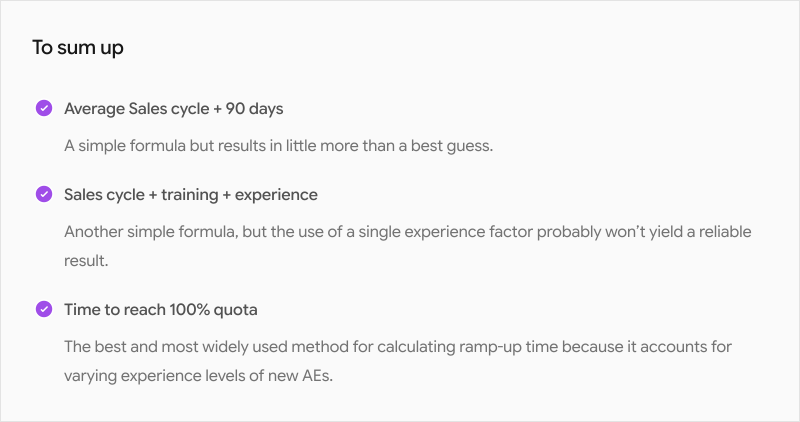
Method 1: Average Sales cycle + 90 days
One method is to take your average sales cycle and add 90 days to it. This is a simple formula that can be useful if you don’t have much historical data on how long it takes your AEs to ramp up.
If adding 90 days seems arbitrary, that’s because it is. You could use any number that makes sense for your business. But, if you don’t have much data to inform the calculation, just know that relying on this formula will produce a result that is little more than a best guess.
Method 2: Sales cycle + training + experience
Another way to calculate ramp-up time is to add your average sales cycle to the time it takes for your AEs to complete their training. Then you would add in some factor to account for their previous sales experience.
The problem with this method is figuring out how to weigh the experience factor. This is because different levels of experience are inherently difficult to account for in terms of how they might impact ramp-up time.
Theoretically, the more experience a new AE brings to the table, the less time it should take to ramp up. However, given the company- and product-specific nature of an AE’s training, that may not always be the case. And even if it is, how much time do you factor in for it? Given these complexities, it’s easier to simply plug in an assumed value when using this method, which may or may not produce a reliable result.
Method 3: Time to reach 100% quota
The best and most widely used method for calculating ramp-up time is to take the average time it takes your AEs to reach 100% of their quota. By using an average, this method takes into account the fact that not all of your AEs are starting at the same place in terms of their previous experience. This fact can have a significant impact on your planning because it tells you not only how many AEs you will need to reach your targets but also when you need to hire them.
In contrast to using a single assumed experience factor to calculate ramp-up time, this method has the experience factor “baked in” as an average of known values. The result is a more accurate representation of ramp-up time that allows you to proactively adjust the timing of your new AE hires based on when you need them to produce business.
Step by step
Calculating ramp-up time in 3 simple steps
Figuring out the ramp-up time for different dimensions in your business is a quick and easy way to improve your sales capacity planning.
The basic process for calculating ramp-up time is pretty simple and can be completed in just three steps. It can be applied to any dimension in your business, such as different types of customers, different geographic regions, etc. This can reveal powerful insights to help you drive your business forward, both in terms of optimizing your sales capacity planning and giving ways to reduce the time it takes AEs to start generating business for your company.
Step 1:
Pull the bookings data for each of your current AEs for their first 12 months with your company.
Step 2:
Plot the month-to-month cumulative bookings for each AE together on a single X-Y graph with time on the X-axis and Bookings on the Y-axis with all starting at time zero (Figure 1). This will show their individual progress in ramping up.
Step 3:
Determine the ramp-up time for each individual AE (i.e. when each one meets quota), then calculate the average ramp-up time for the dimension you’re looking at.
.png)
Proactive Insights
Proactively monitor the progress of your new AEs
You can use average bookings as a baseline for measuring the progress of new AEs.
In addition to using your ramp-up time to inform your sales capacity planning, you can also use the insights it provides to track the bookings of your individual AEs as they ramp up and compare them to the average ramp for all your AEs. As long as each new AE’s bookings are tracking pretty closely with the average ramp or exceeding it, you can be confident that he/she is ramping up as expected.
Let’s look at an example...
Applying this approach to the AEs shown in Figure 1 provides a lot of insight into the ramp-up time for this particular group of AEs.
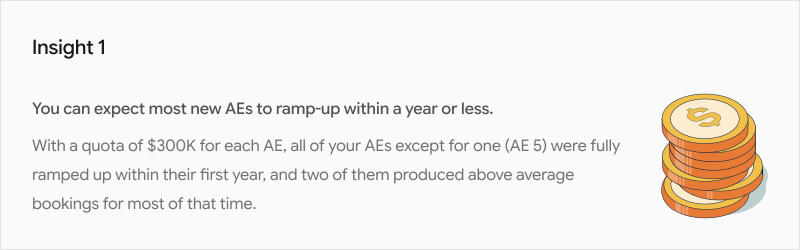
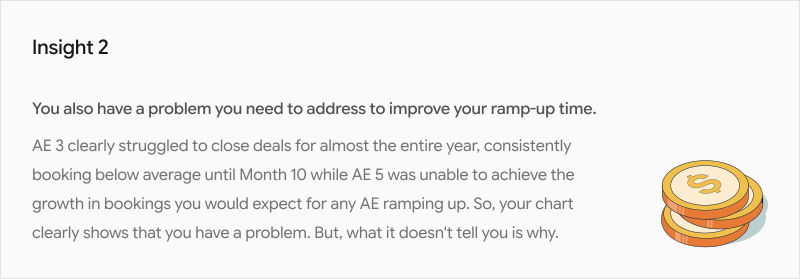
The issues identified in our example (Insight #2) could be attributable to the individual AEs, or they could point to a problem in their onboarding or training. In either case, the actionable insight here is that you have one or more problems you need to address.
If you’re comparing each new AE’s bookings to the average bookings for all AEs on a monthly basis, you can catch a problem like this pretty quickly and proactively take steps to address it (whatever it is) before it has a chance to compromise your growth.

Insights to Action
Making ramp-up time insights actionable in your business
Once you know the ramp-up time needed for new AEs to become fully productive, you can be far more strategic in your hiring.
Ramp-up time calculations are an integral part of your sales capacity planning, which tells you how many new AEs you’ll need to hire to meet your ARR target. Once you know your ramp-up times for the different dimensions in your business, you can use those insights to help you determine where your new AEs are needed on your sales team and when to hire them. You can also use these insights to inform your planning for any additional BDRs and, indirectly, the marketing activities you will need to support your sales pipeline.
Let’s say you have completed your sales capacity planning and now how many new AEs you need to hire. Now, it’s time to use your ramp-up time insights to figure out when the best time is to hire them.
Building on our previous example, excluding AE 5 who failed to ramp up successfully as an outlier, you can use the ramp-up times for each of the remaining AEs from your chart to calculate an average ramp-up time for planning:
- AE 1 ramped up in 10 months
- AE 2 ramped up in 6 months
- AE 3 ramped up in 11 months
- AE 4 ramped up in 10 months
The average ramp-up time for all AEs in this example is 9.25 months. If you’re doing sales capacity planning right, you’ll be adding a margin of safety when determining how many AEs to hire. When using your average ramp-up time to figure when to hire those new AEs, rounding up (assuming this case that it will take your new AEs 10 months to ramp-up) can provide an additional margin of safety.
Trust your gut
What is an “acceptable” ramp-up time for a SaaS business?
While it’s impossible to determine an accurate benchmark for ramp-up time applicable to all SaaS businesses, you probably know about what it should be for your business based on your past experience.
Every business is different and what constitutes an acceptable ramp-up time will vary based on any number of factors specific to your business, such as the complexity of your product, the length of your sales cycle, the types of businesses you sell to, etc. So, even if you could find a benchmark out there, it probably won’t be relevant for your unique business. The good news is that based on your experience, you’d probably recognize a red flag when you see one where your ramp-up time is concerned.
If your average ramp-up time is in keeping with your expectations, you can use it to build out a timeline for hiring, adding in extra time on the front end for your new AEs to get up to speed. However, if you find your AEs are not ramping up as fast as you expected (or fail realization), you have one or both of the following problems to address:
- Their quota is unrealistic and needs to be reduced.
- Your ramp-up time is longer than it should be, and you need to look for ways to improve it.
If your quota is too high, you need to change it. If you don’t, all of your other planning will be flawed and you will undoubtedly miss your ARR target. To ensure this doesn’t happen, you’ll need to go back to your sales capacity planning, adjust your quotas, and recalculate the number of AEs you’ll need. The result will add additional AEs, giving you the extra capacity you need to accommodate that longer ramp-up time.
Shortening your ramp-up time may take a bit longer but is always worth the effort. So, let’s take a look at some of the things you can do to accomplish that.
Accelerating Success
4 things you can do to shorten your ramp-up time
By working to shorten your ramp-up time, you’ll not only accelerate the success of your AEs but the growth of your company, too.
Make sure you have a good onboarding process
.png)
At a high level, you’ll want to make sure you have a play book for your onboarding that outlines everything a new AE needs to know in order to be successful in your company and how they’re going to obtain that outlines 1) everything a new AE needs to know to be successful in your company, and 2) how they’re going to obtain that knowledge.
Provide ongoing coaching

Coaching from managers and veteran AEs in your company can help your new AEs get up to speed faster, especially the less sales experience they have to start with. Here are just a few coaching practices that can bring solid returns in terms of shortening your ramp-up times:
- Practice pitch presentations with them.
- Role-playing exercises in which you coach new AEs on handling objections.
- Give new AEs an opportunity to shadow experienced AEs to see how they manage their pipeline, conduct follow-up, and how they close deals.
Develop a ramp-up plan for new AEs

Developing a ramp-up plan for new AEs will provide a timeline that can help them understand how they should be progressing as they ramp up. It’s important to include key milestones along the way to help you more proactively monitor their progress so you can know in advance when they are veering off track and need additional assistance.
Ramp-up plans should be a key resource for all new AEs, listing your expectations in terms of their skill and sales practices, a timeline for their training with a list of the topics it will cover, and where they can find additional resources they might need to be successful.
Give your new AEs visibility into their progress as they ramp up

If you’re using your average ramp-up time to evaluate the progress of your new AEs as they ramp-up, giving them visibility into that process can encourage them to push themselves harder.
Defining what baseline performance looks like can be a great motivator because it represents the average, and few people want to think of themselves as average. If you show your AEs the baseline, they will strive to exceed it. As more AEs exceed the baseline over time, your ramp-up times will begin to go down.
Smarter Planning
Calculating your ramp-up time is a value-added practice
While it’s possible to use spreadsheets for calculating ramp-up time, they’re extremely limited in their ability to provide the precise insights you need for sales capacity planning.
While the primary purpose for calculating your ramp-up time is to inform your sales capacity planning, the additional insights it can provide and which you can leverage to make your AEs successful faster, makes a good case for routinely monitoring your ramp-up time.
However, if you’re still using spreadsheets for your sales capacity planning, you’re going to find that the different dimensions in your business make calculating ramp-up time inherently complex. You may be able to find templates out there that will help you calculate your ramp-up time, most are just going to give you average across all of your AEs because they are not capable of handling this level of complexity without becoming overly complex in and of themselves.
Drivetrain makes it easy to calculate your ramp-up time regardless of the complexity in your business.
In just a few minutes, you can calculate an accurate ramp-up time for any dimension in your business and seamlessly incorporate the results into your sales capacity planning.
You can also track the ramp-up of every new AE individually to ensure they are progressing as they should, and you can give them visibility into their progress as well. This will give them and you the ability to proactively identify and address any problems that might be hampering their success.
About drivetrain
Scale your business. Predictably.
Drivetrain is a purpose-built strategic finance platform that answers three key questions.


Kirk Kappelhoff is a financial modeling expert with a BBA in Finance & Accounting and nearly a decade of experience at Deloitte, EY, and KPMG, where he built models for pre-IPO companies, M&A transactions, and strategic planning initiatives. At KPMG, he led the Business Modeling Services team, specializing in equity stories and financial forecasts that help high-growth companies communicate their value to investors. At Drivetrain, Kirk writes about strategic planning, granular reporting, and modern FP&A best practices for rapidly scaling finance teams.
.png)
.png)
.png)
.png)