.svg)
.png)
- Signs that indicate it may be time to switch
- Strategic financial planning technologies, defined
- Benefits of a purpose-built strategic finance platform
- Similarities and differences with other software tools
.svg)
.svg)

.svg)

The expectations and demands placed on finance teams have never been higher. The role of the modern CFO has evolved from a role largely focused on financial management, analysis and reporting, to one of a key strategic advisor.
Today’s SaaS CFOs play a significant role in driving business performance and efficiency, maintaining and ensuring the availability of critical data in near real-time to support faster decision-making. In addition, in many forward-looking companies, CFOs are now dedicated to strategic financial planning to better manage risk and identify new revenue opportunities to pursue.
While the responsibilities of CFOs and their finance teams have grown in number and complexity, many are finding that their tech stacks are lagging behind. They continue to work the way they always have, with spreadsheets being the most common tool of choice.
This isn’t surprising. After all, spreadsheets are familiar, flexible, and easy to use. And, they actually work quite well for many of the common activities finance teams are tasked with. That is, until they just don't anymore.
As the complexity of your work continues to grow, the frustrations associated with working through spreadsheets will beg into grow, too.
So, how do you know when it’s time to switch to a purpose-built strategic finance platform, one that provides the powerful financial planning, analysis, and monitoring capabilities you need?
This ebook will help you figure that out.But first, we need to start with acommon language around what “apurpose-built strategic financeplatform” actually is.
What exactly is a strategic finance platform?
Strategic finance platforms help today’s CFOs answer key strategic questions on how to grow faster and mitigate risk.
Strategic finance software, commonly referred to as financial planning and analysis (FP&A) software, is a relatively new breed of technology specifically designed to handle the needs of today’s CFOs and finance teams. Strategic finance software may be a stand alone product designed to integrate with other software or platforms, or it may be a strategic finance platform if the provider offers APIs that can be used to build custom integrations for it.
Both strategic finance software and platforms are designed to help your company answer three key questions:
- What’s the best path to achieve your targets?
- Are you on track to meet your targets?
- How can you course-correct to grow even faster?
The ability to help today’s CFOs and finance teams answer these questions are table-stakes for any strategic finance technology. More specifically, here’s what a strategic finance platform will do for you:
- Help you determine the best way to meet your targets with planning, budgeting, and forecasting capabilities.
- Help you ensure your business is on track to meeting those targets through real-time monitoring capabilities.
- Facilitate faster root cause analysis when you find you’re off track so you can more quickly identify the source of the problem and fix it.
- Reduce risk and uncertainty with “what-if” scenario modeling so you can quickly and easily evaluate different strategies prior to implementing them.
- Eliminate dependency on your IT team with integrations and automations capable of handling advanced, sophisticated data consolidation and manipulations(ETL) from multiple sources.
- Collaborate seamlessly with all the stakeholders in your business through a “single source of truth ”that provides a connected planning and budgeting solution.
A purpose-built tool in a class of its own
Strategic finance platforms share some features in common with other software tools but offer many additional capabilities that CFOs critically need.
It’s easy to confuse a strategic finance platform with other types of software or platforms, such as enterprise resource planning (ERP) and accounting systems and business intelligence (BI) tools. However, when you take a closer look, it becomes clear why purpose-built strategic finance platforms belong in a class of their own.
Enterprise resource planning (ERP) or accounting systems are used to manage the operational aspects of your business finances. And while BI tools do have some features in common with strategic finance platforms, such as the ability to load data from different sources, track important trends in your business, and visualize your data, they cannot understand or model the logic required for financial planning and forecasting.
In contrast, a strategic finance platform uses data from these and other business systems including customer relationship management (CRM) systems, human resources information systems (HRIS),and others to help you manage the performance of your business.
A strategic finance platform will automatically aggregate data from all your key business systems, freeing up more of your time. It will also give you all the features you need to do the planning, tracking, and analysis necessary for strategic decision-making in your business.
How can you tell when it’s time to switch to a strategic finance platform?
As the complexity of your business grows, your frustration with spreadsheets will grow right along with it.
Aside from the laborious and time-consuming nature of manually working with multiple spreadsheets, there are other ways you can tell that it may be time to trade up for a more powerful solution. Here are a few obvious signs, which are among the most common reasons that CFOs decide to make the switch.
REASON 1 : You’re always behind in having visibility into your business performance
When you’re relying on spreadsheets todo your FP&A, it can take 2-3 weeks to develop your monthly reports, making it almost impossible to determine how your business is doing at any given time or month to month. This is particularly problematic when it comes to tracking your pipeline movements. Your pipeline is the life blood of your business, and any downward trend could spell real trouble for your business.
Being responsive to pipeline changes requires day-by-day (or at least a week-by week) visibility. But when you’re tracking your pipeline manually, if you do have a problem, you’re not going to know it for atleast a couple of weeks. And even then, it’s going to take you some time to figure out why it’s happening so you can fix the problems.
Here’s what this analysis looks like if you’re still using spreadsheets…
First, you get a CSV data dump from a bunch of different systems such as your ERP, HRIS, CRM, and accounting systems.
Then you have to consolidate all that data into a spreadsheet, reviewing it for errors and then double-checking (maybe even triple-checking) to make sure there are no errors. Best-case scenario, you’re looking at a week to get this all pulled together just to start performing your analysis. Often, it takes longer than that.
You’re really in a no-win situation here. You could just make a best guess and make some operational changes to solve the problem, but you know that any decision you make without the benefit of a root cause analysis could actually make it worse.
And even if you do your analysis, you’re working with data that’s already stale. By the time you get it done, the problem maybe far worse or it may have partially reversed itself. Without real-time data, the path forward is never clear making it difficult to be confident that any decision you make will be effective.
REASON 2 : You can’t seem to plan/budget/forecast at the speed your business requires
Your company is growing, and you’re struggling to keep your models updated. You’re expanding into new territories or new sales channels, accepting new currencies, maybe adding to your product line.
For each and every change in your business, using spreadsheets to do a new scenario analysis takes 2-3 months. Once you get it done, you still have to get stakeholder input(which isn’t easy because collaborating through email is a pain).
Of course, it doesn’t help that every budget owner has his or her own way of forecasting costs and revenue and are using different spreadsheets to do that. When department plans keep changing, there’s no easy way to see how those changes might affect other numbers in your model.
Scenario modeling hasn’t always been this hard. Reconciling your numbers to develop your models was probably a lot easier when your company was smaller.
The pain and frustration you’re now experiencing is due to the growing complexity in your business and the fact that using spreadsheets for modeling simply isn’t a scalable process.
You may have tried using some of the planning and forecasting templates you found online. But, you probably found them to be too inflexible for your rapidly changing needs and just as much (if not more) effort to tailor them for your unique business.
Using spreadsheets isn’t scalable because when you’re working with multiple systems that aren’t integrated, you invariably spend a lot of time stitching the data together. And, you can never fully trust the data because the manual processes required to compile and work with it are inherently error-prone.
As the number of data types and data sources you’re required to work continues to grow, the amount of time it takes to reconcile them for use in your models grows, too. You’ll need ever-longer lead times for planning, ultimately limiting your planning activities to once or maybe twice a year. By the time you finally get your plan done, all the underlying data that might have made it useful for decision making is already out of date.
REASON 3 : You’re unable to respond quickly enough to new opportunities or threats in the market
You never have enough time to do the analysis you know you need to drive your business forward. Identifying unprofitable areas of the business and making critical decisions around resource allocations and headcount changes depend on your ability to analyze departmental spending against revenues and other factors that might be affecting your business.
With your data spread across several different systems, you’re spending so much time on tedious manual data consolidation and error-checking that you often feel like you’re on a treadmill, constantly working to revise previously reported numbers.
For example, if your actual moving 3-month average ACV dropped to $18K instead of the $20K planned, you’ll need to account for that in the future months and provide revised guidelines. While you’re busy doing that, you’re worrying that you may be missing important changes in the market that can impact your business.
And you very well could be. You know how dynamic the SaaS industry is. You could have competitors suddenly undercutting your prices to steal part of your market share, or a sudden spike in attrition. There may be new patterns emerging in your sales that you need to respond to quickly. Maybe your sales cycles are getting longer or your average deal size is shrinking. Or you notice fewer prospects coming into your pipeline. When faced with sudden changes like these, you’re always playing catch-up and losing ground in the process.
REASON 4 : Collaboration is difficult and achieving alignment is even harder
There just seems to be no easy way for your finance team and your stakeholders to collaborate and make the kinds of strategic, data-driven decisions you need to grow the business.
Putting together your plans and budgets is an arduous process involving a lot of back-and-forth with department heads via emails and constant follow-up. Tracking these communications is hard enough, but when you also have to keep up with the different versions of the spreadsheets you’re sending and receiving, it’s next to impossible to develop efficient workflows across teams (and even harder to trust the data you’re working with).
If you’re struggling with collaboration, you’re probably also struggling with achieving alignment around the strategy for your business. It seems like for every metric, different teams each have their own definition and their own way of calculating it. As a result, you end up spending more time figuring out what a given metric means than you do working together to achieve it.
How many of these signs are you seeing in your business?
If you’re experiencing even one of these issues, you’re probably ready to start thinking about switching to a strategic finance platform.
All of the issues described here have a very real and negative impact on the success of your business. And, the more of them you’re struggling with, the greater that impact is.
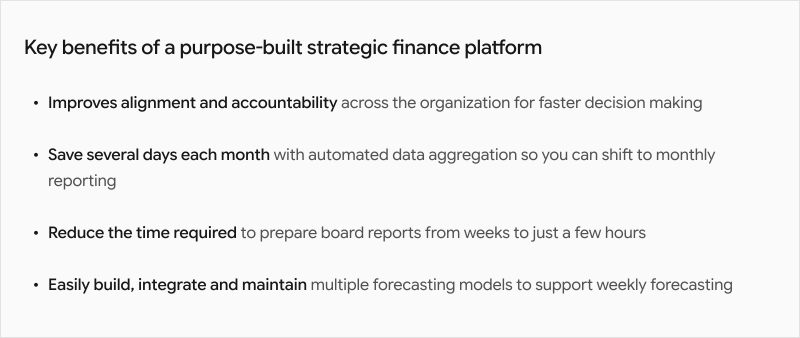
Companies that use strategic finance platforms have a real-time view of their business, experience enormous gains inefficiency, and are able to easily extend their runway to proactively make better decisions faster. The table below summarizes some of the biggest benefits you can realize with a purpose-built strategic finance platform like Drivetrain.
Drivetrain is a game-changer
With a purpose-built strategic finance platform like Drivetrain, you can become the kind of strategic advisor your company needs to drive its growth faster.
The ability to confidently use your data to inform strategic decision making is a core function of today’s CFOs. If you don’t feel like you can do that with your current spreadsheet-based processes, it’s probably time to level up with a strategic finance platform like Drivetrain to better support you in your role as a key strategic advisor in your company.
Drivetrain is a purpose-built strategic finance platform for SaaS companies that can help you:
- Automate data consolidation with shared metric definitions using out-of the-box integrations with 200+ popular business systems including ERP, CRM, HRIS, BI, accounting and more.
- Get real-time visibility into your business in seconds.
- Do faster planning and (re)forecasting that seamlessly scales with your growth and business complexity.
- Collaborate easily within an intuitive UI that offers the familiarity of the spreadsheets you’re used to working with (minus all the manual work and data quality concerns).
With Drivetrain, you can quickly see where and why slowdowns or accelerations are happening in your business and use those insights to achieve more rapid growth. With the big picture, real-time perspective of your business that Drivetrain provides, you can provide key strategic guidance to help your leadership confidently make solid, data-driven decisions at just the right times to move your business forward.
About drivetrain
Scale your business. Predictably.
Drivetrain is a purpose-built strategic finance platform that answers three key questions.
.svg)

Kirk Kappelhoff is a financial modeling expert with a BBA in Finance & Accounting and nearly a decade of experience at Deloitte, EY, and KPMG, where he built models for pre-IPO companies, M&A transactions, and strategic planning initiatives. At KPMG, he led the Business Modeling Services team, specializing in equity stories and financial forecasts that help high-growth companies communicate their value to investors. At Drivetrain, Kirk writes about strategic planning, granular reporting, and modern FP&A best practices for rapidly scaling finance teams.
.png)
.png)
.png)
.png)